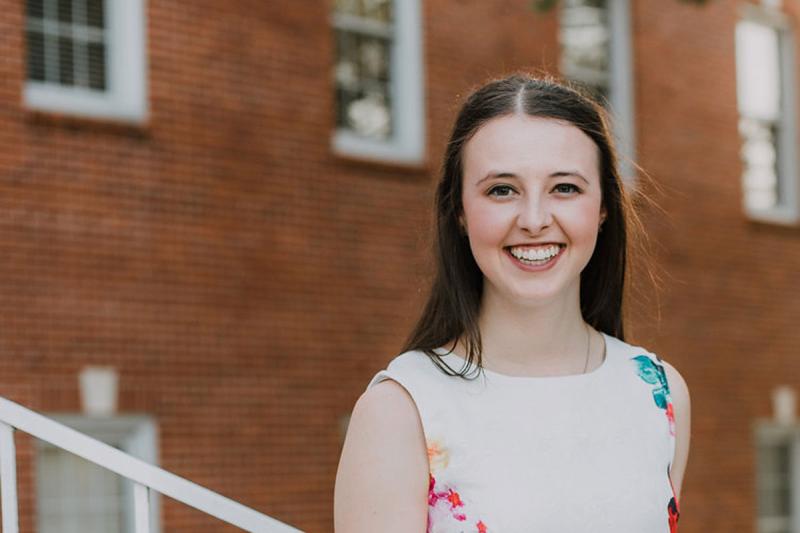
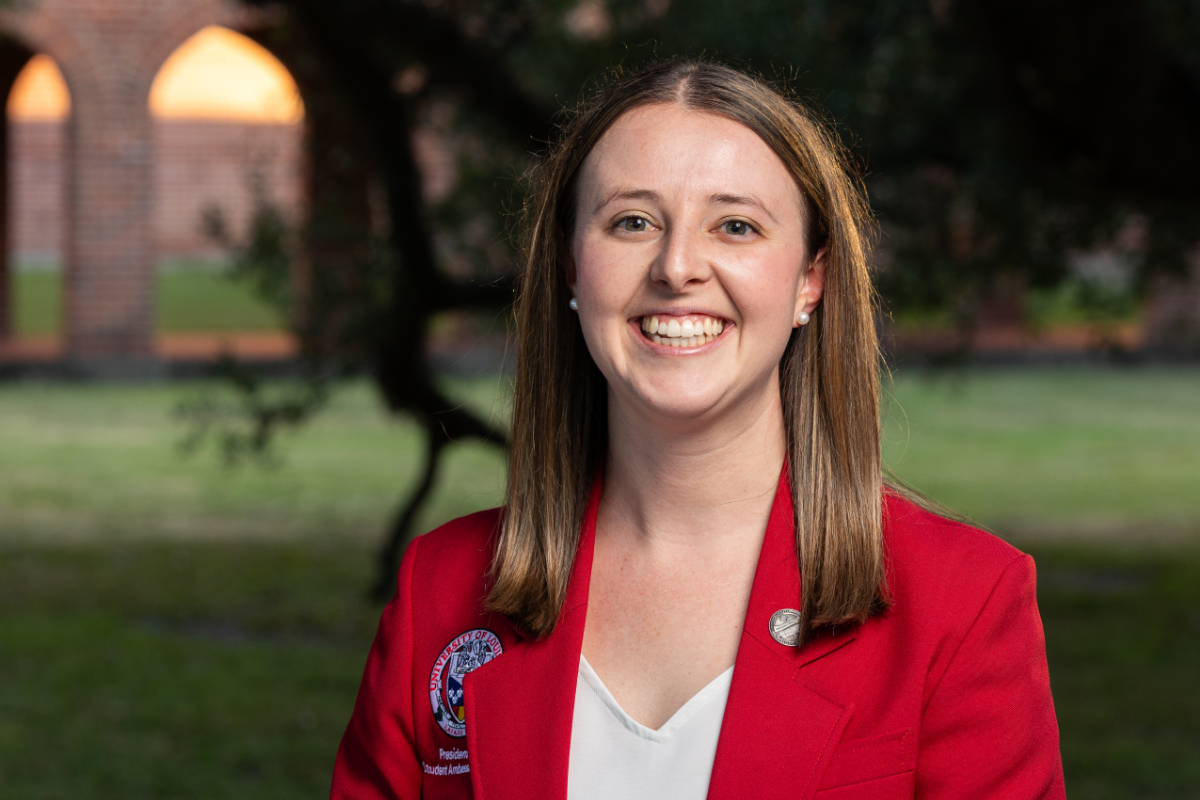
For Mary McMahon, it was a no-brainer to choose the University of Louisiana at Lafayette as her educational home. First, she earned her Bachelor of Arts in Speech-Language Pathology & Audiology, then a Master of Science in Speech-Language Pathology.
After graduating, she worked as a speech-language pathologist (SLP) in adult outpatient settings and at traumatic brain injury centers.
“I loved working in clinical practice, but often felt like I was consistently left without answers on how to best provide therapy to help my clients reach their goals. I realized that if I wanted to be part of the solution to this problem I was experiencing, I would need to engage in research to fill these gaps. I began researching potential mentors I could study under in a variety of Ph.D. programs, and I reached out to Dr. Ryan Nelson, the Communicative Disorders Department Head,” she said.
Mary believes that the University and department hold a special energy that illuminates beyond measure, which is why she returned to earn her Ph.D. Applied Language & Speech Sciences.
“There is a culture of growth, support, and empowerment in the Graduate School, and I am so thankful that I’ve been given the opportunity to continue my studies here.”
Life as a Ph.D. student at the University
Throughout Mary’s journey, she’s become very involved.
As a member of the Aphasia Center of Acadiana, Mary has been able to follow her passion to help those with communicative disorders.
“Aphasia is a language disorder that sometimes occurs following a stroke or brain injury that affects the language-dominant hemisphere of the brain," she said. "Through this organization, I’ve led support groups, aphasia-friendly book clubs, and social groups focused on educating our surrounding community about aphasia and providing opportunities for social interaction. While the Aphasia Center of Acadiana provides services to people with aphasia, it also provides opportunities for speech-language pathology graduate students to gain clinical experience working with people with aphasia.”
The UL Lafayette Speech Language and Hearing Center has provided an Intensive Comprehensive Aphasia Program (ICAP) in collaboration with the Aphasia Center of Acadiana, where graduate students gain clinical experience and attend community outings with people who have aphasia.
As a presidential student ambassador, Mary attended the State of the University Address, where faculty and staff come together to celebrate, and leaders review the prior year and share what they hope to come.
“This meeting is often uplifting and reminds everyone in attendance how far we’ve come, and gives us hope to look forward to where this University can go," she said.
"I’ve also really enjoyed working on fundraising events and having the opportunity to speak to alumni about their time here at UL Lafayette," she said.
"The University has changed so much over time, and it is always so interesting to see that despite the changes that take place, one thing rings true – the student experience at UL Lafayette is memorable and unlike any other university.”
Research experience and what’s next
Mary’s primary area of research is aphasia, but she is open to other aligned research opportunities. She has collaborated with various professors from different expertise backgrounds, like stuttering and intellectual and developmental disabilities.
She has also collaborated with researchers from other universities. “In my second year of the Ph.D. program, Dr. Jamie Azios was awarded a NIH R15 grant with her Co-Primary Investigator, Dr. Jaime Lee at The University of Utah. As part of my assistantship, I served as the Project Manager for this grant. This allowed me to gain experience writing manuscripts for publication, presenting at numerous conferences, and providing mentorship to undergraduate research assistants,” she said.
Mary believes her Ph.D. experience is enriched because of her willingness, the opportunities presented, and the supportive community on and off campus. She encourages graduate students and Ph.D. candidates to embrace vulnerability because it may lead to fruitful conversations and opportunities. In addition, she advises graduate students to enroll in a program with supportive mentors and helpful faculty.
“Throughout this time as a Ph.D. candidate, I’ve learned the importance of being self-motivated," she said. "After entering into Doctoral Candidacy, much of that time is dictated by the student. You’re no longer enrolled in traditional classes with papers and deadlines, and much of the work you’re completing is at your own pace.
"While there was some adjustment to this at first, I quickly realized that I needed to create goals and deadlines for myself to stay on track to graduate,” she said
She currently teaches as a visiting instructor in the Communicative Disorders Department and after graduating, Mary plans to continue working in higher education.
She said, “Through these experiences, I’ve realized working at a university in whatever capacity I’m called to serve in is what I hope for regarding my future.”
Take your education to new heights by pursuing a graduate degree in communicative disorders at UL Lafayette.