
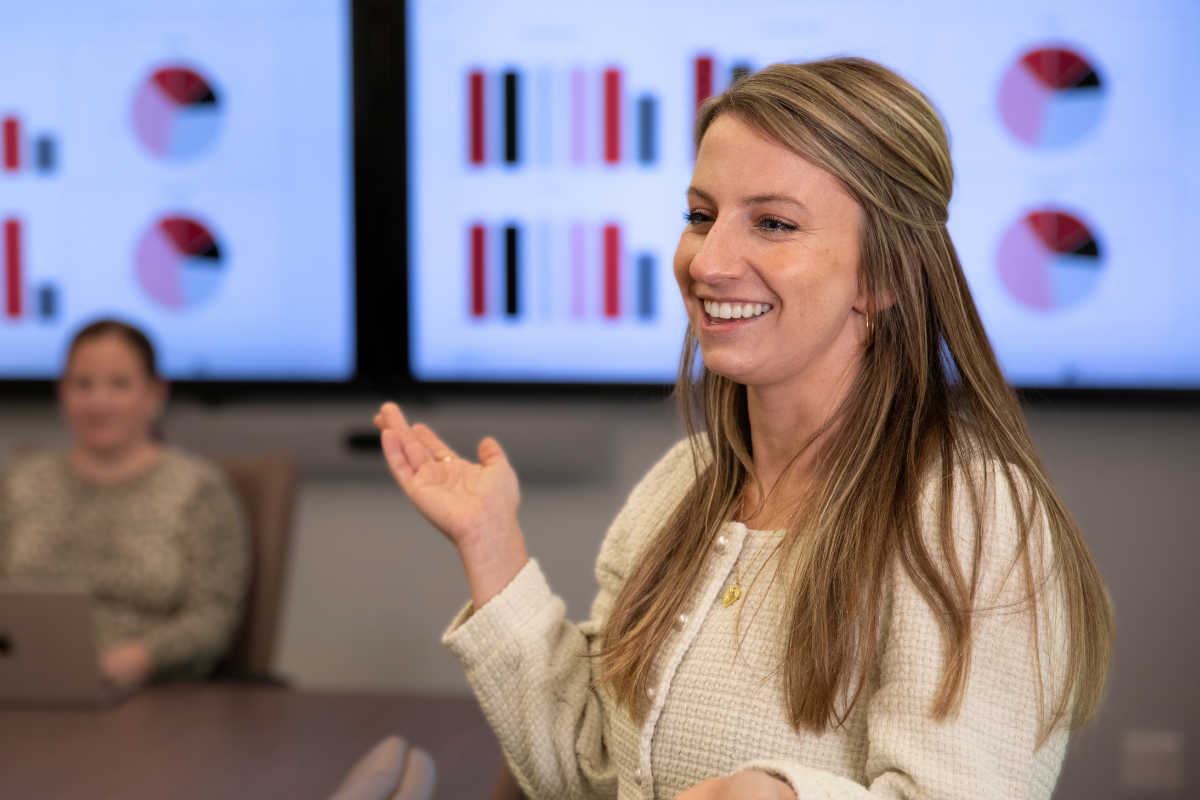
Amie Meche didn't set out to build a career in analytics — but once she got there, she was hooked.
After earning her undergraduate degree in health information management from the University of Louisiana at Lafayette in 2016, she joined SCP Health as a revenue integrity auditor.
Over time, her role became increasingly data driven. By the time she reached a senior revenue analyst position, analytics had become the focus of her work.
“I wanted to advance my education, but it had to be the right program,” says Meche.
When she saw that UL Lafayette offered an online master's in informatics program, she knew it was the right fit. The curriculum built directly on the analytical work she was already leading.
“I knew UL Lafayette would be widely recognized as a good program. Plus, it was affordable and just worked for my life.”
Built for Real Life and Real Work
When Meche started the program, her life was already full.
She was working full time from home: running code, refreshing dashboards, and managing analytics workflows. At the same time, she was raising two young children. School drop-offs and pickups filled the margins of her workday.
Evenings were for dinner, bedtime routines and then, finally, coursework.
“That seven to 11 o’clock window was my homework time nearly every weekday,” she says.
The online format provided flexibility while her own structure and routines kept everything on track. She treated the program like another job with clear deadlines and nonnegotiable time blocks.
“I’m very Excel-minded. Everything in my life is in spreadsheets,” Meche says. “If I needed to read a certain number of pages, I broke it down by day. I gave myself due dates. I don’t know if I would have been successful without those organizational skills.”
That system kept small tasks from becoming last-minute scrambles. In an online program, she says, it’s easy to underestimate the week until it’s Saturday night and everything is due Sunday.
Tuition required the same level of intention. Meche took the number of courses she could comfortably afford and used the University’s payment plan to avoid student loans.
“That payment plan was the only way I was able to do this,” she says. “Knowing how much it would cost me a month and setting that aside in my mind helped me to say, ‘I'm going to make this work, because this is a priority for me.’”
Coursework That Translates Immediately
The program’s value translated directly into Meche’s day-to-day work.
In INFX 531: Distributed Database Management, she found herself digging through GitHub and Reddit to test code solutions. What began as an assignment soon became something she could apply at work.
“It was like a game for me,” she says. “I really enjoyed that, and I was able to utilize some of that code immediately in my work to automate things.”
The program also challenged how she defines good analytics. In INFX 581: Business Process Management, which focuses on user experience and data governance, she learned to approach data with stakeholders in mind.
“Dr. Sonya Hsu, my professor for that course, taught us to gather your stakeholders, identify what they need, and try to fill that gap and communicate,” she says. “Her class was one of the most difficult I've ever taken, but classes like that really push you to think outside the box and do your best.”
That perspective changed how she handles requests at work. Instead of simply delivering a report, she considers what the end user needs and how they will use the information.
With eight years of experience as an analyst before starting the program, she could apply concepts immediately. She believes that timing shaped her experience.
“If I had started the master’s program right after graduating, I would have missed that connection.”
Growing with Intention
Ten years into her career at SCP Health, Meche isn’t looking to pivot. She’s looking to deepen.
“I really respect their goals and how they help patients,” she says. “We’re pretty much a health care provider, and that resonates with me. I’d like to grow with the company.”
The M.S. in Informatics equipped her to do just that. It wasn’t about changing careers — it was about gaining confidence, sharpening her skills, and seeing new ways to apply them in the work she already loved.
She stresses that you don’t need a computer science background to succeed.
“A lot of my peers didn’t necessarily have an analytical background, but they still boasted about how much they learned,” she says.
“You shouldn’t be afraid you don’t qualify or it wouldn’t apply to your work. This is a set of skills you need if you want to work with analytics.”
For students considering the program, she has a few guiding principles: stay organized, be intentional, and don’t hesitate to reach out.
“I was pretty much always the first one to ask a question,” she says. “Even though this was an online program, that helped me connect with classmates and professors. I’ve even made a few friends along the way.”
Level up your analytic skills with UL Lafayette’s M.S. in Informatics online.