
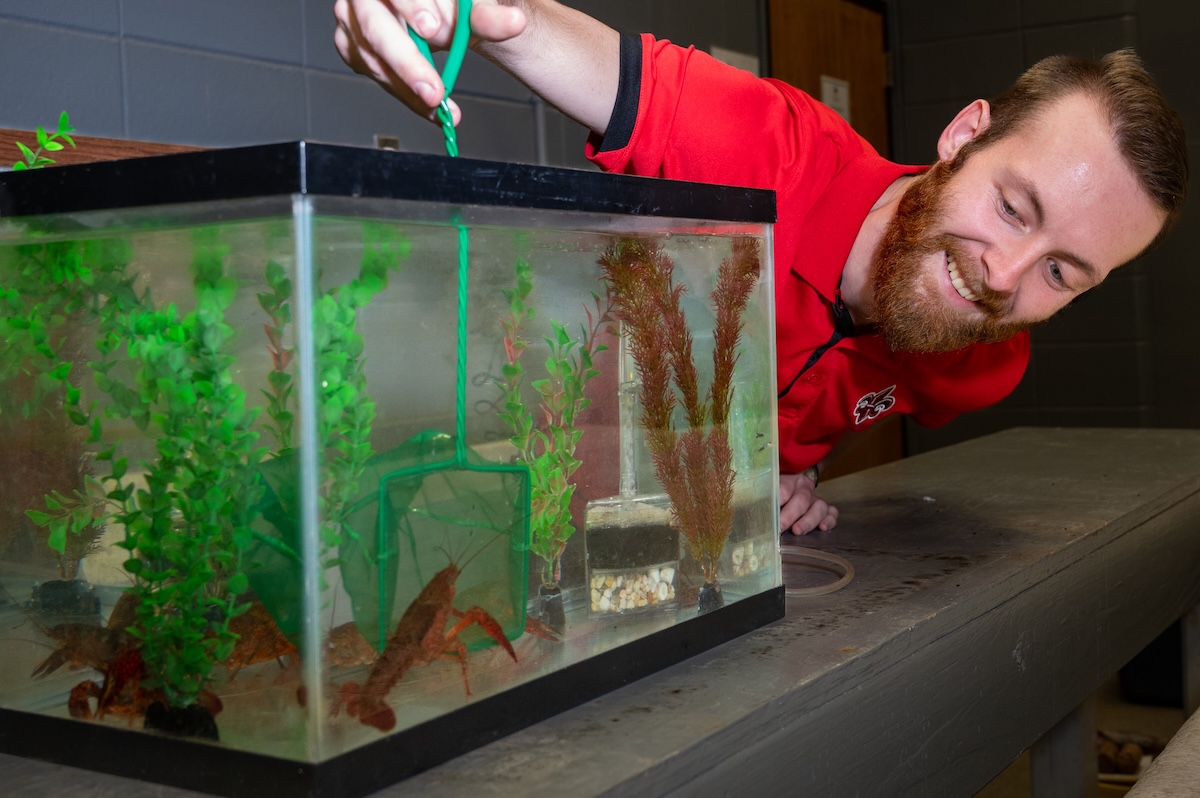
The crawfish industry annually contributes more than $300 million to Louisiana’s economy. A research study at the University of Louisiana at Lafayette is proving it could also help control invasive carp in Louisiana rivers.
Dr. Kelly Robinson and Dr. Emily Kane from the School of Biological Sciences in the Ray P. Authement College of Sciences join La Louisiane podcast to discuss their research, funded by the Louisiana Department of Wildlife and Fisheries, that tests the effectiveness of invasive carp as crawfish bait. The project, conducted in partnership with UL Lafayette Graduate School students and Nicholls State University, could incentivize large-scale harvest of invasive carp by commercial fishermen.
Learn more by listening to the conversation with La Louisiane managing editor Marie Elizabeth Oliver on KRVS. You can also watch it on UL Lafayette’s YouTube channel or read an edited transcript below.
Marie Elizabeth Oliver
It's peak crawfish season in Louisiana. Producers here supply 90% of the country's crawfish. And I want to talk about your research. But before that, just kind of on a broad level, why is crawfish such a touchstone here? I know you're both scientists, but in your work, why do you feel like it's such a big deal here in Louisiana?
Kelly Robinson
I'll start on that. I think it's because it's it brings together family, it brings together community. A crawfish boil, by its very nature, is highly social. You gather around a big table, you're talking, you're peeling, you're eating, you're sitting, you're resting, you get up and you get your second helping. It's like our spring Thanksgiving. It's a cornucopia of seafood.
Emily Kane
I didn't grow up here. I've only been in Louisiana for about five years now, but I grew up in Maryland, and blue crab is a huge thing. I see a lot of parallels with that. And what Kelly says, every time there's a big birthday celebration or something. “Oh, let's go out for crabs.” So, I think there's a lot of family and there's a lot of culture surrounding eating crawfish.
Marie Elizabeth Oliver
You have funding from the Louisiana Department of Wildlife and Fisheries. I said we're here to talk about crawfish. We are, but it's also about carp, the invasive species. So, can you share a little bit about your research and how that came to be?
Kelly Robinson
Sure, I'll get started on that. So, the Louisiana Department of Wildlife and Fisheries is very motivated to help manage invasive carp, which is a fish species that's in our rivers. And these fish are probably most famous for jumping out of the water when disturbed by like a boat motor. They have been problematic in the Upper Mississippi Basin for a couple decades now, but they finally have migrated down to our neck of the woods, and so we're trying to they're trying to they're trying to figure out ways to manage them. So, these fish are filter feeders, meaning they basically open their mouths and eat everything in the river.
Emily Kane
Everything that's small enough.
Kelly Robinson
That's true. You know they can fit in their mouths so they can be competitors and with native fishes for common prey. And so, you know, we want to have some there's concern about managing them. And one of the ways that they're trying to do that is incentivize a market for a fishery.
Marie Elizabeth Oliver
OK, so and the tie in for the crawfish is that then it's incentivizing people to fish.
Kelly Robinson
So crawfish are collected and harvested in traps in the farm ponds, also in the Basin, right? You'll put out a pillow trap, and you have to bait that trap with something to attract the crawfish, and so fishermen or folks in the Basin will either use raw fish bait, so that can be menhaden, commonly known as pogie, gizzard shad, pieces of gizzard shad. Buffalo is another kind of cut fish bait. And then there's also artificial baits, these are dry pellets. They look like range tubes, kind of like cattle feed, and those are made with fish meal, so basically dried fish that's pelletized and things like that that gets in the trap. And, you know, across all these baits, they're stinky. That's the goal. Crawfish like stinky things, right? So, the thought was, if crawfish like things like pogie and gizzard shad, let's try carp — see if they're attracted to the carp.
Marie Elizabeth Oliver
So that's where it comes in. And I know field work is really a big piece of this research. So, can you share a little bit about that field work and what you've been doing out there?
Emily Kane
Kelly, you've been doing most of the field work. I went out with you once, yeah, and I just took pictures.
Kelly Robinson
Well, Emily has been leading the in lab-controlled studies.
Marie Elizabeth Oliver
OK, so it's both, it's the field work and the lab work, working in unison.
Kelly Robinson
Because when you're in the field, you have a lot of uncontrolled variables, weather, other things that the crawfish want to eat, crawfish predators, bycatch and all these things. And so, I brought Emily in and her lab to help us with controlled behavior studies, so that we could pair those two to make sure that we were seeing the same outcomes.
Marie Elizabeth Oliver
I see, so you have crawfish in your lab?
Emily Kane
Well, not currently, but I did, yeah. We're done with those projects, and the student that's working on it is analyzing all of the data right now. But it's nice because we could do very controlled, you know, one crawfish in a tank, two baits on either side of the tank. Which one does it go to? And there's a lot of variation there. But it does seem like we're maybe getting some preferences, or at least it doesn't seem any different than some of the other fish baits.
Marie Elizabeth Oliver
OK, because I was going to ask you, any sneak peeks at the results that you could share?
Emily Kane
There's a lot of videos. I think you tested 90 crawfish and, you know, two trials a piece. So, it's like 180 GoPro videos that are filming for three hours. So, there's a lot of data that he's going through. But from what we've looked at so far, it looks like it's at least not any worse than the other kinds of baits in the lab.
Kelly Robinson
And that's kind of an unusual question for scientists to ask. Usually, we're seeking contrasts, right? You know: Is something is A different than B? And in this case, we're actually asking: Does the carp attract crawfish just as well as the other things that farmers and fishermen are using?
Emily Kane
And I think what's also cool that we're trying to see is, you know, we have a little bit better control over sex ratios that were tested and things like that. And so trying to see, for example, I think he already has some differences based on whether it was a male or a female being tested, and so that might relate back to what we see in the field, and some of the patterns in terms of when the crawfish are hibernating and when they're not or whether it's male or female, and whether those preferences maybe shift across the season. So, we can add some of the mechanistic explanations of what they're seeing in the field.
Marie Elizabeth Oliver
How do students play into this and why is that an important part of this project?
Kelly Robinson
Students are hugely important to this work. I could not have accomplished the science without my students. So, this project is supporting at least three students, not to mention a number of undergraduate researchers who are helping with the field work and processing of samples and things like that. So, this is a very student driven project. My graduate students are the ones who go out and, in the morning, put on the waders and bait the traps and are out there pushing the boat, and then they have to go out and fish and record everything. And, I get to stay in the shed, especially when it's raining. When it's raining, I help them count the crawfish. Ethan Horn has been instrumental in this project. He was actually the undergrad who very much started it and is now a master student on it. I think he just defended his proposal last week.
Emily Kane
Congrats, Ethan!
Kelly Robinson
He has measured over 6,000 individual crawfish.
Emily Kane
Yeah, he's really something. I think just in general, Kelly and I have a similar perspective, that I think students are just important in general, in research, and no matter what we do, I mean, at least for me, I try to find a way to involve as many students as want to be involved in it. And so, the crawfish project is currently funding a master's student in my lab, and he wasn't intending on coming here and doing that as a master's, but then he got involved in it, and then has switched over to doing that for the masters. So, you know, it gave him an opportunity that we didn't expect at the beginning either. I think just anybody who's interested, student wise, I love getting people involved in the research, and you can't do it without them. There's no way. I don't have enough time in the day.
Marie Elizabeth Oliver
Yeah, and fishing is not like the worst thing you have to do as a student.
Kelly Robinson
No, it is not.
Emily Kane
There are really hard days, though.
Kelly Robinson
There can be hard days, and when you ever you start a new project, there's a lot of iteration in terms of you find problems you never expected. And so, the first few field days can be quite long, because, like, well, that did not go as we expected. We have to make an adjustment here, for example, I get too excited about data, and I told them to measure all the crawfish in the traps, and then that took way too long.
Emily Kane
How many crawfish was that?
Kelly Robinson
Well, we were measuring 100 crawfish per trap, and we, I would that we were there ‘til nine at night. And in fact, it was my husband who was the sound of reason, and he's a man who works hard, and he said, “Kelly, you need to come home. Please send your students home.”
Marie Elizabeth Oliver
So, your husband is a crawfish farmer. Was that collaboration, having that real-world piece, important to this project?
Kelly Robinson
It has been such an important industry-academic partnership. So, we get all the crawfish for undergraduate work from him, and he's a wholesaler, so he gets crawfish from a variety of crawfish farmers across St. Landry Parish, but we've been using his ponds as our experimental sites. I get to use his equipment. Actually, last Valentine's Day, I got a shipping container as a present to store all my science.
Emily Kane
Very romantic, jealous!
Marie Elizabeth Oliver
And I think I'm assuming, it's beneficial for businesses to have this research. I mean, theoretically, this would be a beneficial opportunity.
Emily Kane
I actually had somebody call me from out of the blue, one of the local crawfish farmers down in Vermilion Parish. And he said, “Where can I get some of these carp?” And said, “I'm sorry, they're not for sale right now.” And he said that he had used some previously, and he said, “I'm really open to this, and I want to know when you have these carp products.” He just called me out of the blue on my office phone. So, I think there's definitely an industry desire for this.
Marie Elizabeth Oliver
Yes, and I know you're also working with the team from Nichols. How did that collaboration come to be?
Kelly Robinson
Chris Bonvillain is our collaborator at Nichols, and he is a crawfish ecologist. That is his expertise, and so he's leading the portion of the project that's focused on fishing in the Basin. So, like wild caught crawfish.
Marie Elizabeth Oliver
OK, and it's a similar, similar test, with the carp?
Kelly Robinson
Yeah, we're trying to make sure we're doing everything the same in the Basin as we do in the pond, so that we can make a fairly solid comparison.
Marie Elizabeth Oliver
And are they on a similar timeline?
Kelly Robinson
They start fishing a little later than us, because they have to wait for the river to flood up, right? So, they're affected by water levels, and for that reason, they actually get to fish longer than us there. They'll probably end in, like, June, July — because, again, it's dictated by the river levels, you know. And at that time, usually the farmers are starting to take the water out of their ponds.
Marie Elizabeth Oliver
And then I know you probably have a next phase of this. What's the next part of your research?
Emily Kane
Well, I think, for me, my job is done.
Kelly Robinson
Emily did a great job.
Marie Elizabeth Oliver
Packing up the crawfish.
Emily Kane
Well, hopefully the student will graduate in the next year, and we've got other projects. So, I'm not actually a crawfish biologist. I'm more of a fish biologist, but anything wet, really. We do a lot more organismal things, so more on the behavior side. And so that's where we came in. I think the project has shifted a little bit more to more of the field work at this point. So, it'll just be Kelly.
Kelly Robinson
I can drag her out to help measure crawfish.
Emily Kane
I'll do it.
Kelly Robinson
But in the in the next phase, we are working with a new feed meal to basically make an artificial bait that I was talking about, that pelletized bait that's more aligned with what is available commercially right now. So, farmers really are hesitant to things that are different. They don't like change. And so, we want to make a product that is something that they're familiar with. And so, we've gotten that more aligned now in this next phase, and we're going to be testing different percentages of carp fish meal in that pellet. So, the idea is: Is it more attractive at 10, 15, 7%? What's the variability?
Marie Elizabeth Oliver
I see. Well, anything else before we go about the project, or just about crawfish? I know it's a topic people love to talk about.
Kelly Robinson
Please enjoy crawfish. Go out visit your local crawfish retail space, and buy yourself a pound or two, and get your friends.
Emily Kane
Right, and thanks for supporting, Louisiana Department of Wildlife & Fisheries, because they're the ones who are supporting us doing this work.
Marie Elizabeth Oliver
Wonderful, wonderful. We're so glad that you're that you're doing this work and thank you for being here today. We appreciate it.
Emily Kane
Thank you.
Kelly Robinson
Thank you for having us.
Check back next month for more discussions with members of our university community. KRVS is listener supported public radio for Acadiana, a service of the University of Louisiana at Lafayette.
Photo caption: Graduate student Ethan Horn is part of a team of UL Lafayette biologists and undergraduate and graduate students are examining the effectiveness of invasive carp as crawfish bait, research that’s being funded by the Louisiana Department of Wildlife and Fisheries. Photo credit: Emily Kane / UL Lafayette Ray P. Authement College of Sciences
Video production: Kade Parker / University of Louisiana at Lafayette Audio production: Clint Domingue / KRVS