
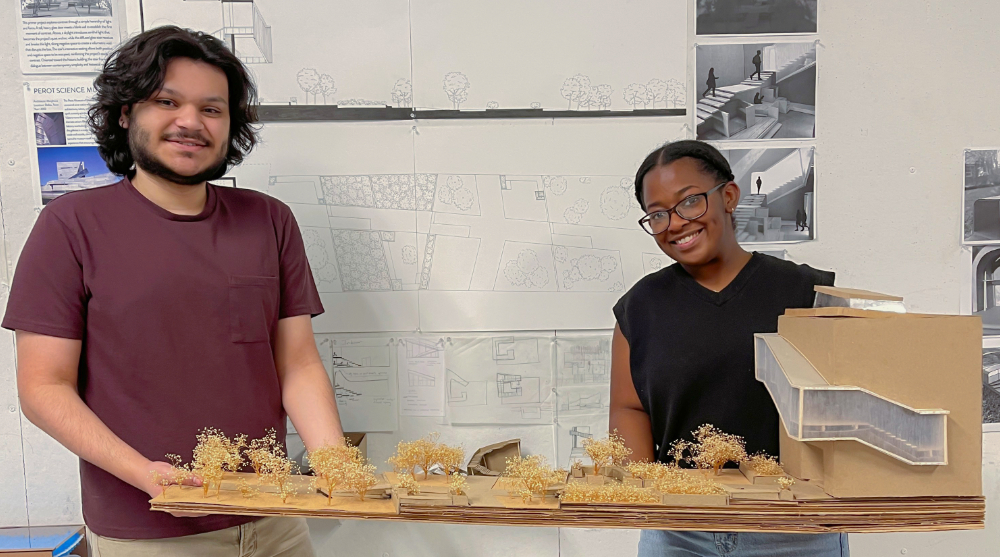
Two University of Louisiana at Lafayette students have stepped onto the world stage with their design of one of architecture’s most fundamental elements – the staircase.
Danyia Johnston and Landon Fuselier, who are each pursuing master’s degrees in architecture from UL Lafayette’s College of the Arts, earned the Buildner Student Award as part of The Architect’s Stair competition.
It was judged by a group of top industry professionals from across the world. Judges awarded first, second and third places, six honorable mentions, and the Buildner Student Award, which is named for the company that coordinates the competition.
Johnston and Fuselier, who have each earned bachelor’s degrees in architectural studies from the University, were recognized for Social Play. Faculty advisers Brad Michael and Ashlie Boelkins, assistant professors in the School of Architecture and Design, led the students’ work.
“Their design resulted from rethinking everyday spaces, exploring how an ordinary staircase can become a place for gathering, socializing and connecting people, and it demonstrated how creative design can improve everyday experiences,” Michael explained.
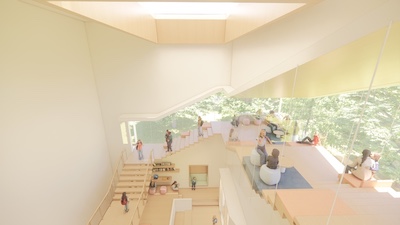
The concept anchoring Social Play – which features wall lounges, soft stair seating, a mounted desk and community platform spaces – was to create an environment that fostered interaction, gathering and a sense of community.
Johnston explained: “We wanted anyone who encountered the building and the space to feel like there were multiple ways to communicate. We thought about the idea of community, what community feels like, and how can people feel they’re in a safe space to interact with others.”
Project partners Fuselier and Johnston, according to the judge’s summary, succeeded. Social Play elevated a traditional staircase from a purely functional structure into “a multi-level social environment where circulation, seating, work, gathering, and informal occupation are integrated into a single spatial system.”
Circulation, in an architectural context, refers to pathways people use to move through a space. Stairs – like hallways or entrances – are part of a building’s circulation network. Transforming a staircase from a basic mode of transport into “an experience for its users,” according to Fuselier, began to take shape with a class assignment.
The assignment involved reading an article that detailed the observations of an architect who watched a succession of people routinely bypass a staircase in favor of a nearby elevator. “In my mind, I was like, ‘What would encourage people to use stairs instead of an elevator?’” Fuselier reasoned.
A key component of Social Play is that it provides views of both the lobby and outdoor landscaping. The switchback staircase, which features two 90-degree turns, stretches upward and alongside large walls of glass.
“Then, we were like, ‘how can we further this experience?’” Fusilier said. “So, we decided to put different types of seating to inform different types of activities on the stairs.”
The result was a welcoming, community-oriented design, where different forms fit together to support a range of daily activities, including sitting, working and congregating.
“A lot of people tend to think of a staircase as just a circulation path, but when you’re thinking about the idea of community and communicating with others and socializing there are lots of areas where people can cross paths,” Johnston said.
Learn more about The Architect’s Stair competition and its award-winning projects.
Photo caption: UL Lafayette graduate students Landon Fuselier and Danyia Johnston, who are each pursuing master’s degrees in architecture, have earned international recognition for their innovative staircase design. Submitted photo