
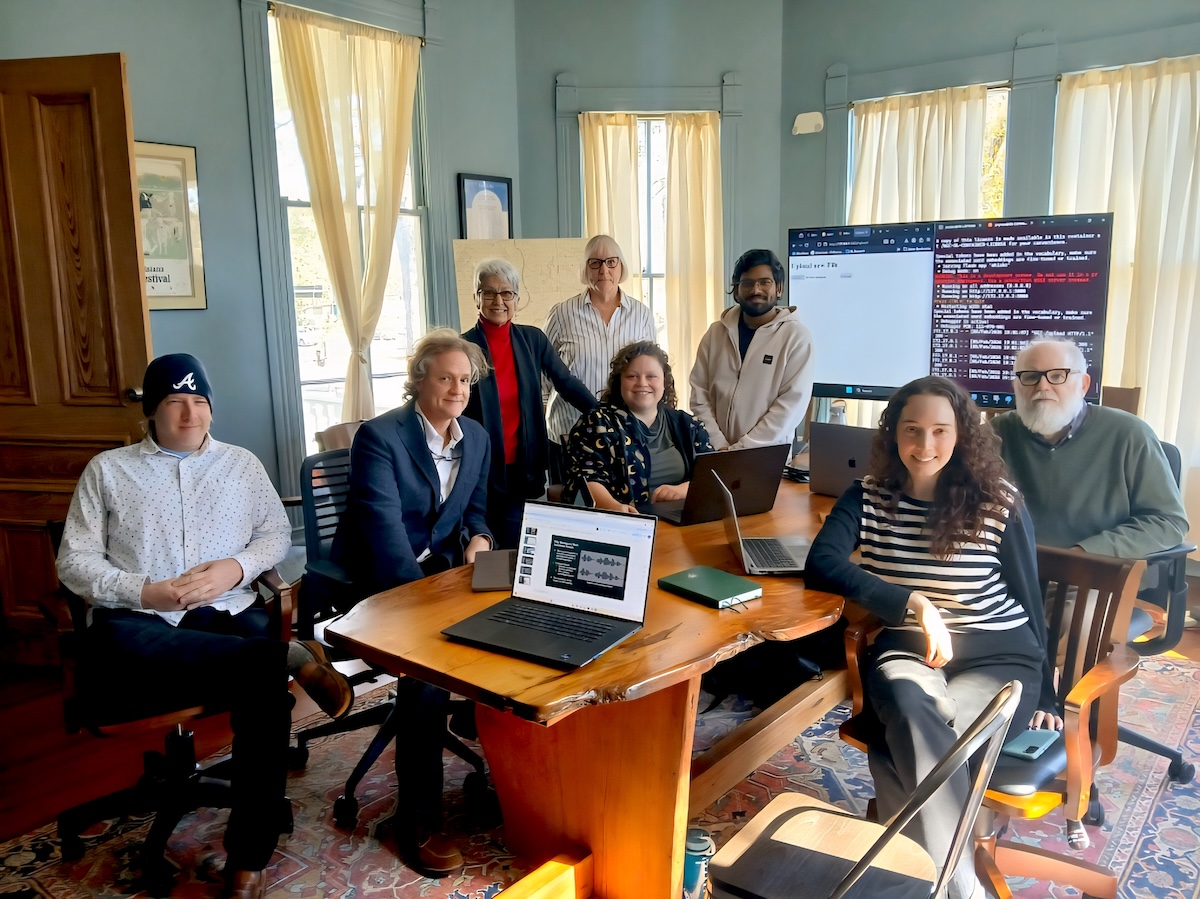
The Center for Louisiana Studies at the University of Louisiana at Lafayette has launched the LaFLEUR (Louisiana AI for French Language Exploration Understanding and Research) Project, marking its first effort in developing AI tools that can efficiently navigate the nuances of regional dialects.
The announcement was part of Oh Yé Y(ai)lle, a symposium dedicated to the preservation of Louisiana’s oral traditions through the lens of artificial intelligence.
Dr. Joshua Caffery, Center of Louisiana Studies director, explained the LaFLEUR Project was inspired by the time he attempted to learn a traditional Cajun song at home. He asked his Amazon Alexa to play a track by the legendary Cajun fiddler Dewey Balfa, but the machine, optimized for a global market, responded by playing the pop hits of Dua Lipa.
“That just struck me as a frustrating thing,” said Caffery. “What happens when we are increasingly integrating these systems into our lives that is privileged on certain kinds of information?”
The digital disconnect exists because large-language model machines use information throughout the whole internet, increasing the risk of local dialects being lost. The LaFLEUR project aims to bridge this gap.
The symposium’s title, Oh Yé Y(ai)lle, mirrors this duality. It can be perceived as a cry of alarm at the rapid pace of technology or a screech of delight familiar to the high-pitched exclamations in Cajun and Zydeco music.
“I would say we are somewhere in the middle of the two, Oh Yé Y(ai)lle, we are cautiously optimistic but also wary,” said Caffery.
The technical challenge exists because the regional language is spoken or sung, not read, so the field recordings in the center’s archives are often scratchy and full of background instrumentation.
When the team tested a standard, untrained model on a recording of storyteller Evelia Boudreaux, the results highlighted a significant linguistic gap. The AI, trained on standard French, misheard the local phrase “ça fait, un bon jour” ("so, one fine day") and transcribed it as “il s'est fait un bonjour,” or "he said hello to himself."
“These errors occur because the machine struggles with the phonetic, syntactical or grammatical differences unique to Louisiana,” said Dr. Rachel Doherty, assistant director at the Center for Louisiana Studies.
To close this gap, the team is building what they call “Ground Truth,” a gold-standard dataset of high-quality transcriptions vetted by human experts. This process involves the manual labor of chunking audio into precise 30-second segments to ensure the text matches the sound.
"We're trying to create an automatic system that works seamlessly without a lot of human effort,” said Peyton Leathem-Boe, a research scientist at the Informatics Research Institute.
By working to establish an efficient blueprint, the LaFLEUR team hopes to create a tool that allows the public to bring in recordings of their own ancestors to receive dependable transcriptions.
The team sees this foundation as a gateway to preserving Louisiana French and other indigenous languages, ensuring these voices are heard by intelligent machines of the future. They said the work is not a technical exercise, but a fight for cultural continuity in a digitized world.
Caffery summarized their urgency with this metaphor: Dewey Balfa tossing an AI-generated potato to the next generation, challenging them to "lâche pas la patate" (don't drop the potato).
"Will the soul of Cajun and Creole culture be part of thinking computers in the distant future?” Caffery asked. “We want to make sure that these machines have soul in the future, and I think this is a good way to do that."
This story is part of La Louisiane, the official award-winning magazine of the University of Louisiana at Lafayette, covering research, students, faculty, alumni, and Louisiana's Cajun and Creole culture since 1989. Recognized by the Council for the Advancement and Support of Education, La Louisiane publishes features, profiles, and a monthly podcast produced in partnership with KRVS 88.7 FM, an NPR affiliate and service of the University of Louisiana at Lafayette.
Photo caption: LAFLEUR project team (from left) Chris Segura, Dr. Joshua Caffery, Amanda Lafleur, Sally Johnson, Peyton Leathem-Boe, Anudeep Kalyadapu, Dr. Rachel Doherty and John Sharp Photo credit: Center for Louisiana Studies