
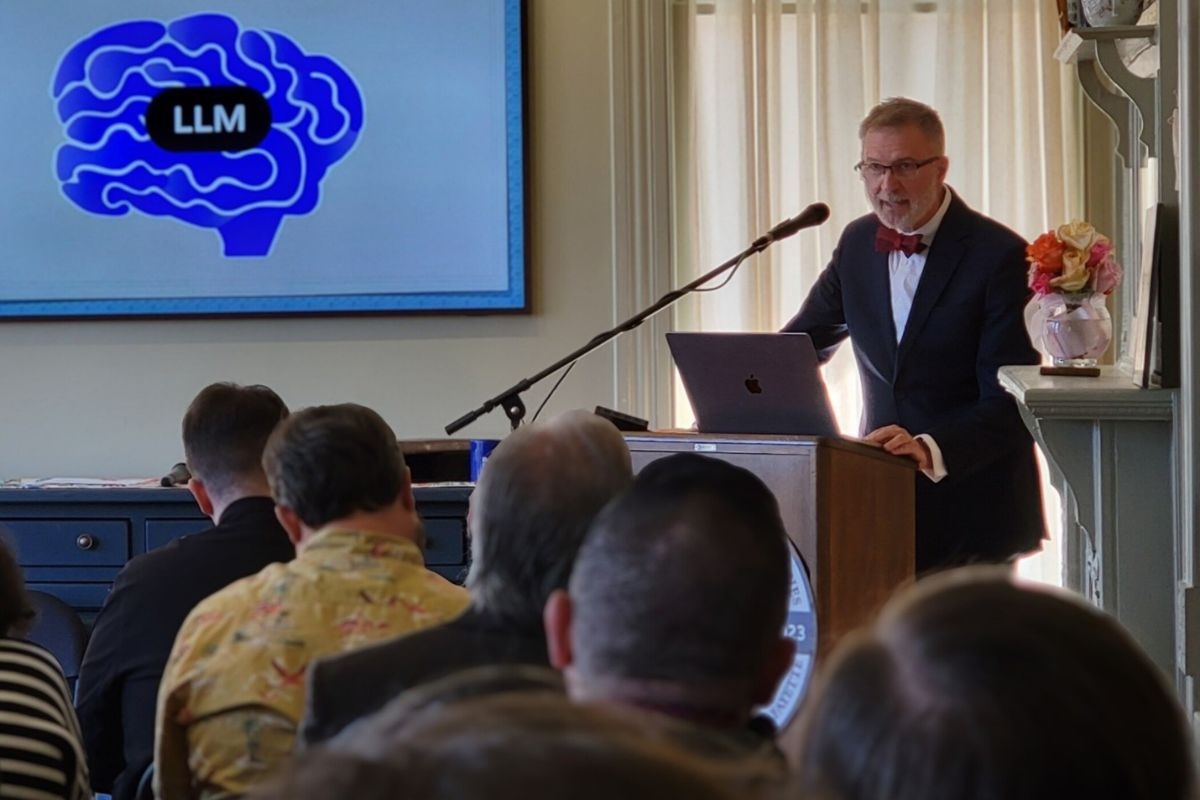
Almost a decade ago, Dr. Boisy Gene Pitre purchased his great-grandfather’s 1959 Opelousas home and discovered a trove of old documents hidden inside the attic, all containing information about the Dixie Land Ranch, once a 1,000-acre farming operation in St. Landry Parish.
"Imagine this is placed in front of you: A chaotic mass of paper, decades of records left untouched in the South Louisiana attic for nearly 60 years,” Pitre said. “No order, no index, no road map."
Some could see this as a fire hazard but to Pitre — who began his career in the software industry — it was historical data he could mine using modern technology.
This idea began his path to being named a Fellow by the Center of Louisiana Studies at the University of Louisiana at Lafayette, where he received his master's and doctoral degrees in computer science. His work is both archival and forward looking, using AI to better understand the past.
The project began with a chaotic mass of 10,000 brittle artifacts such as receipts, time books, ledgers and more. Pitre worked on converting these physical items into machine-readable text through scanning and Optical Character Recognition (OCR). At the time of the discovery, Pitre knew the technology wasn't ready to handle the scale of the archives.
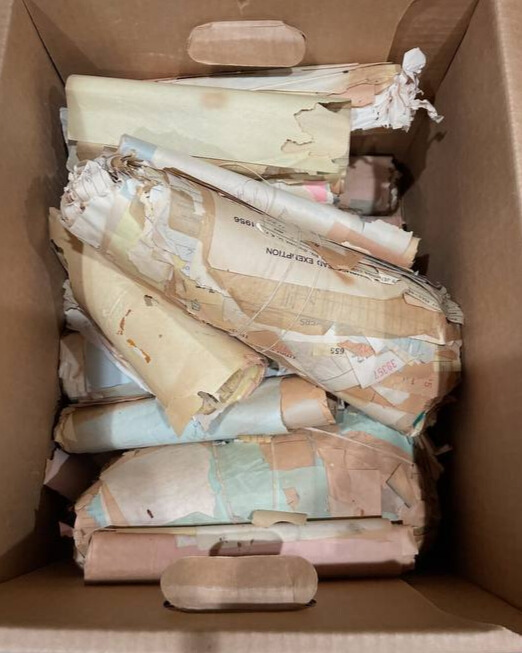
“When I ran into these documents in 2018, AI really wasn’t where it is today,” said Pitre. “I knew I would eventually be deferring some of the work that needed to be done."
Pitre said he believes he won’t have to wait long.
“I think technology has changed drastically in the last two to three years,” said Pitre. “And will continue to change even faster in the next year or two than I have seen in my whole career.”
Pitre is using Large Language Models (LLMs) to efficiently organize disordered and old data into a structured database, allowing researchers to engage with historical collections at a scale and depth that would otherwise be impractical.
"LLMs excel at helping us identify patterns, relationships and recurring themes across vast collections of documents,” Pitre said. “Once you understand the questions that can be asked, then you can start asking even more interesting questions. So, it's a force multiplier."
Pitre said this process reveals new connections people would otherwise miss in a manual review. Most notably, the LLM surfaced the names of Eraste and Calvin Carriere, 20th century Creole musicians, revealing they had worked for Pitre's great-grandfather.
Despite his excitement over the potential benefits, Pitre remains a realist. He recounts a specific instance where AI stated his great-grandfather died 7.5 hours after a vehicle accident in 1961. Pitre traced this back to a 1963 (Opelousas) Daily World newspaper article that contained a factual error, which AI faithfully reproduced.
“LLMs don’t have an independent sense of historical truth; they work with the information we give them,” said Pitre. “That’s why human review, cross-checking and domain knowledge remain essential.”
This insight has shaped his approach to ground AI systems on structured, verifiable data straight from the sources so future outputs are trustworthy.
“What makes this work distinctive is that I’m not just scanning documents; I’m creating structured datasets that allow AI systems to analyze and interact with this material,” said Pitre. “This opens the door for new forms of access while ensuring that local history is preserved in a way that remains usable for future generations.”
This story is part of La Louisiane, the official award-winning magazine of the University of Louisiana at Lafayette, covering research, students, faculty, alumni, and Louisiana's Cajun and Creole culture since 1989. Recognized by the Council for the Advancement and Support of Education, La Louisiane publishes features, profiles, and a monthly podcast produced in partnership with KRVS 88.7 FM, an NPR affiliate and service of the University of Louisiana at Lafayette.
Photo caption: Dr. Boisy Gene Pitre is working as a fellow with the Center of Louisiana Studies at the University of Louisiana at Lafayette, where he is using AI systems to better understand the past. Photo credit: Center for Louisiana Studies