The University of Louisiana at Lafayette is strengthening its connections with NASA as it expands its role in Louisiana’s growing aerospace industry.
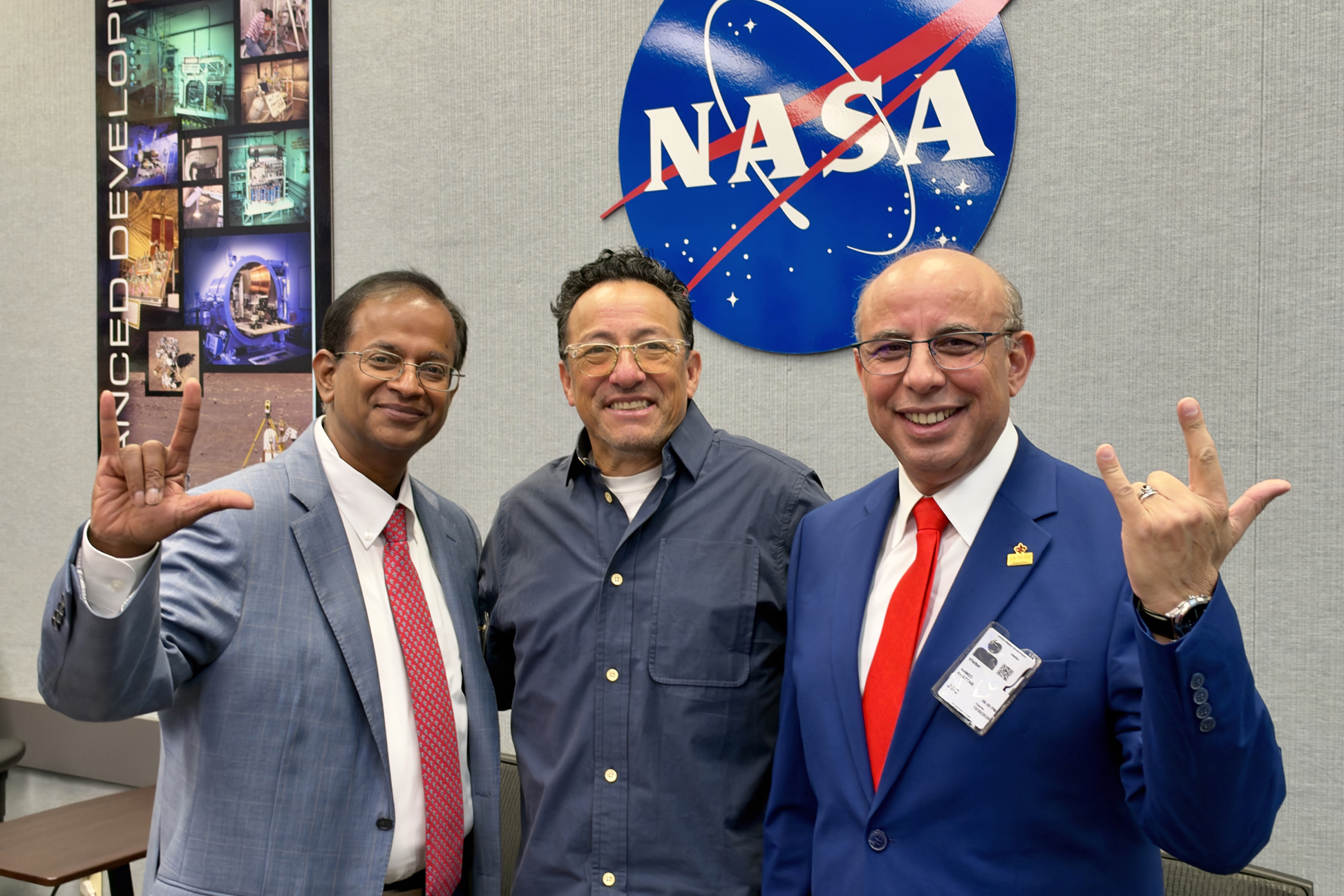
University President Dr. Ramesh Kolluru led a delegation to NASA’s Johnson Space Center in Houston last week to explore opportunities for collaboration in research, education and workforce development.
“The University of Louisiana at Lafayette has a tremendous opportunity to contribute to the future of aerospace through our students, faculty, research and partnerships,” Kolluru said. “Our conversations at Johnson Space Center were an important step toward building a relationship that can create new opportunities for our students while supporting the workforce and innovation needs of NASA and the broader aerospace industry.”
University and NASA leaders explored opportunities for student internships, faculty engagement, collaborative research and industry-informed curriculum development. NASA representatives also shared insights into the technical and professional skills needed by the next generation of aerospace professionals. The discussions included a possible framework for future collaboration.
UL Lafayette’s contributions to space exploration date to the dawn of the Space Age in the 1950s. Generations of University graduates have helped advance America’s space program, contributing to missions from Apollo and the Space Shuttle to the International Space Station and NASA’s Artemis program. At least six UL Lafayette alumni have contributed to Artemis II, the agency’s first crewed mission around the Moon in more than 50 years.
The University has also established its own legacy of aerospace research and innovation. In 2007, UL Lafayette became the first university in Louisiana to launch a student-built satellite through its CAPE program. Two more satellites have followed, with a fourth in development. Today, its research spans autonomous systems, satellite technologies and aerospace electronics, supported by facilities such as the Nick Pugh Aerospace Electronics Research Laboratory.
SpaceX’s development of the world’s largest spaceport near Pecan Island is accelerating the growth of Louisiana’s aerospace industry and creating new demand for a skilled workforce.
Dr. Ahmed Khattab, dean of the College of Engineering, said UL Lafayette is positioning itself to help meet that demand through expanded academic offerings, research and industry partnerships. Khattab was among the University leaders who participated in discussions with NASA.
Beginning in Fall 2027, the College of Engineering plans to offer an aerospace engineering concentration within its bachelor’s degree program in mechanical engineering, along with a minor in aerospace and autonomous systems. The Ray P. Authement College of Sciences is developing a space computing systems concentration and minor focused on technologies essential to modern space missions.
“We are intentionally aligning our academic offerings with the changing needs of the engineering workforce,” Khattab said. “As we build our aerospace engineering program beginning in Fall 2027, relationships with organizations such as NASA will help us prepare our students with the knowledge, skills and experiences they need to succeed.”
Photo caption: Edgar O. Castro, chief of the Propulsion and Power Division at NASA’s Johnson Space Center in Houston, is flanked by Dr. Ramesh Kolluru, UL Lafayette president, right, and Dr. Ahmed Khattab, dean of the College of Engineering. (Photo credit: Amy Windsor / University of Louisiana at Lafayette)
UL Lafayette strengthens NASA collaboration to advance aerospace research, workforce development
Published