
A routine day of excavation work turned into a prehistoric discovery when a local landowner unearthed a mammoth tooth on his property earlier this month. Curt Matte was operating a bulldozer at a dirt pit near his home in Branch, La., when he struck something unusual beneath the surface.
Initially thinking it was a small salt deposit, he continued working until fully uncovering a large tooth the following morning. After finding what looked like more fossilized bones and a tusk, Matte stopped excavation work in the area.
After making a few calls, Matte was referred to the University of Louisiana at Lafayette’s Dr. Jennifer Hargrave.
"I knew I had something special, so I wanted professionals to handle it," said Matte.
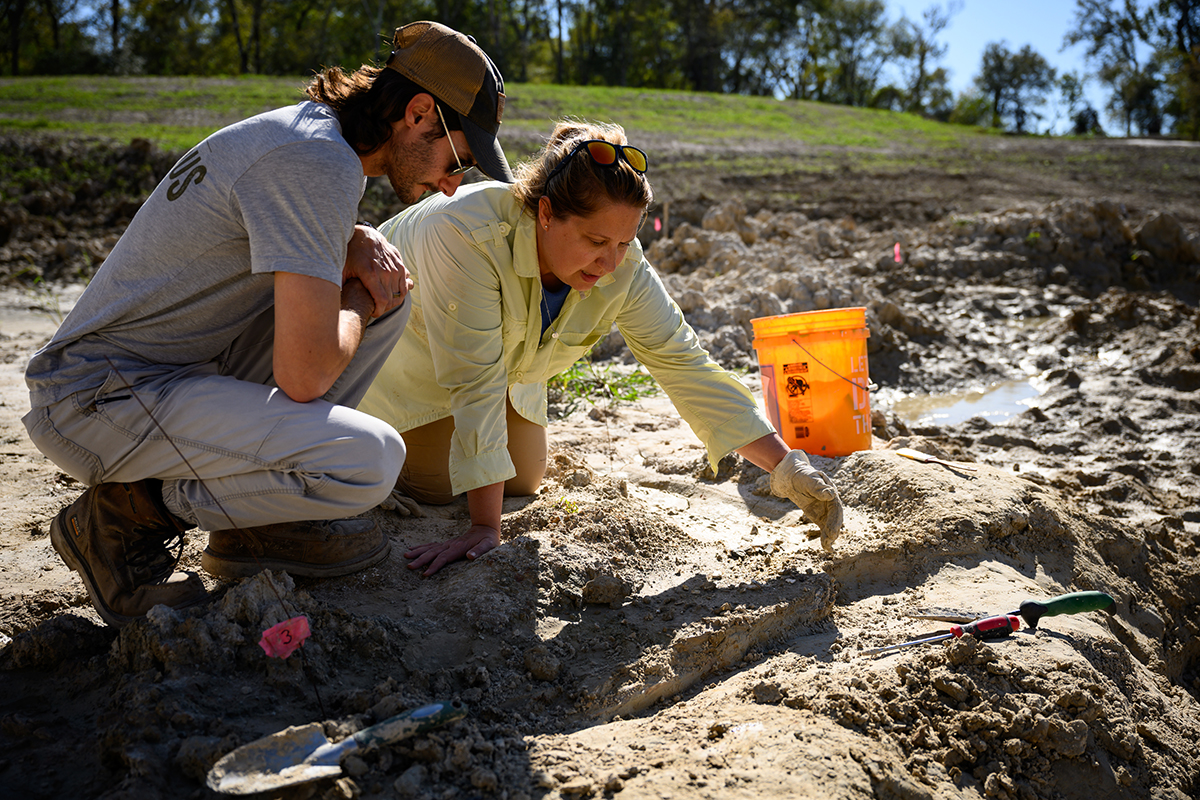
Hargrave, assistant professor in the School of Geosciences and director of the UL Lafayette Science Museum, initially visited the site, where standing water initially prevented a full excavation. Through a little “paleontology by feeling,” Hargrave said she was able to identify what she believed could be portions of the animal's lower jaw and tusks.
This discovery adds to a growing collection of Ice Age fossils found throughout Acadiana, including a recently discovered mastodon tooth in Church Point, La., last year. Discoveries like these offer a glimpse into Louisiana's prehistoric environment.
During the most-recent Ice Age, roughly 18,000 years ago, advancing glaciers pushed animals farther south, where Louisiana remained ice-free, providing access to food and water. Hargrave said that her preliminary estimation puts the tooth’s age between 10,000-12,000 years old.
“As the Ice Age advanced across North America, it was pushing farther south, meaning everything that was living there was also being pushed farther south,” said Hargrave. "Louisiana remained ice-free, so we had food sources and the water sources available for these animals.”
The excavation also offers hands-on research opportunities for UL Lafayette students studying paleontology. Undergraduate and graduate students are assisting with the excavation, gaining practical experience that Hargrave said will benefit their future studies and careers.
While Ice Age fossils have been discovered across Acadiana, finding them often depends on knowing what to look for and having the right conditions to expose them. Hargrave said recent news coverage and Ice Age exhibits at the UL Lafayette Science Museum in downtown Lafayette have helped raise awareness of the region's prehistoric past, encouraging more residents to share their discoveries with researchers.
"So maybe before, when somebody finds something, it's a cool treasure for their family. But now, we're seeing a lot more sharing it with us, letting the scientists know, and then we can share that with the whole community," said Hargrave.
Photo caption: Chase Sylvester, left, and Dr. Jennifer Hargrave, assistant professor in the School of Geosciences and director of the UL Lafayette Science Museum, examine fossil remains at a dig site near Branch, La. Sylvester holds a master's degree from the School of Geosciences. (Photo by Paul Kieu / University of Louisiana at Lafayette)