
Weighing up to 165 tons, blue whales are the largest animals in Earth’s history, more than double the size of Titanosaurs, its biggest dinosaurs. A study by Dr. Craig McClain, a professor in the Ray P. Authement College of Sciences’ School of Biological Sciences, and Stanford University researchers indicates why blue whales grow so large.
Study results, which were published in the Proceedings of the National Academy of Sciences academic journal, are based on a comparison of almost 7,000 living animals and fossils to examine variables that impact size. The findings also point to why marine animals, in general, are much bigger than the biggest creatures on land.
It all boils down to environment and diet. Aquatic mammals grow bigger because buoyancy lessens gravity’s effect on their bodies. Gravity, on the other hand, limits growth in large land mammals. Their weight, at a certain point, simply eclipses the bone strength necessary to support them.
Water spurs growth in warm-blooded marine animals another way. It pulls heat from an animal’s body more quickly than air. Marine mammals simply need to be bigger to stay warm. Bigger bodies, however, consume greater amounts of energy.
“What we found is that aquatic mammals are drawn toward an optimal body size, because of energetic tradeoffs,” McClain explained in a Popular Mechanics article that summarized study findings. “The ‘sweet spot’ is where (energy) income comfortably exceeds costs.”
Researchers also concluded that blue whales are the ocean’s largest mammals because they feed on krill, shrimp-like crustaceans that swim in dense schools. The whales can inhale hundreds of pounds of the tiny, nutrient-rich krill into their enormous mouths with one swallow, a process called filter feeding. Most marine species find food much less efficiently, by chasing more elusive individual prey.
“Blue whales did not just get big because they could,” McClain said. “They got big because the ocean started serving food in a way that rewarded giants.”
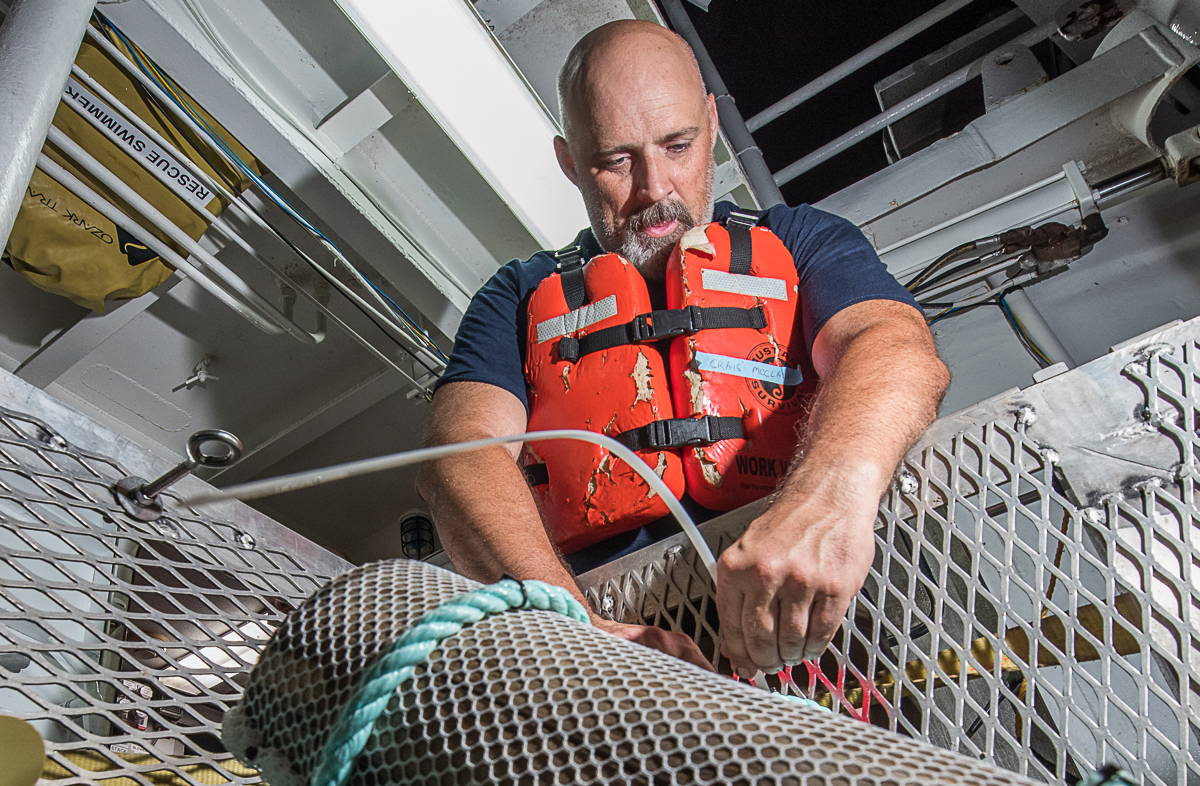
Photo caption: Research conducted by the Ray P. Authement College of Sciences’ Dr. Craig McClain, shown conducting a previous study in the Gulf of Mexico, indicates why blue whales get so big. Findings of the current study also point to reasons the giant whales are the biggest creatures in the sea. Submitted photo