
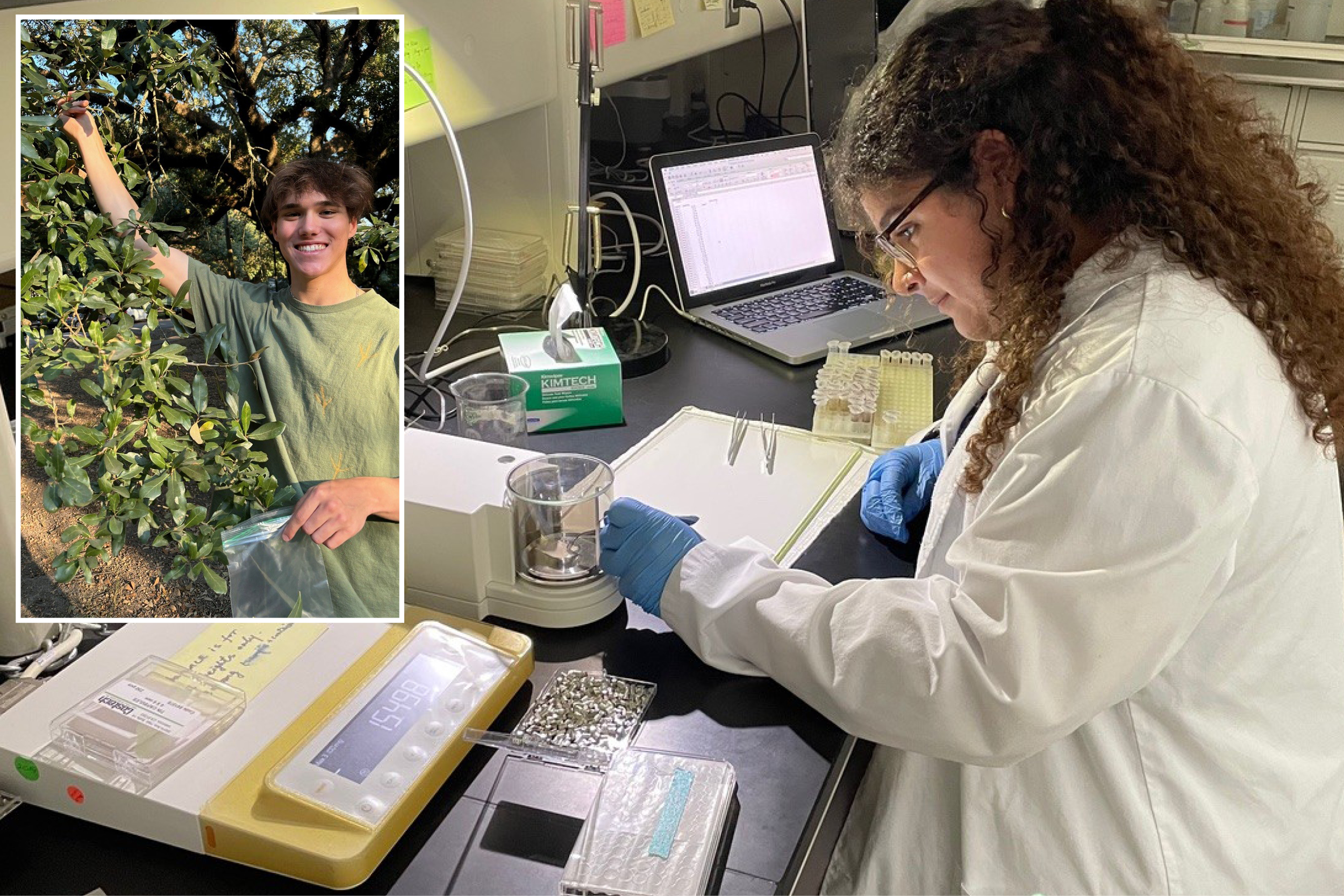
Student researchers have analyzed the carbon chemistry of southern live oaks on the University of Louisiana at Lafayette campus to determine variables that alter the trees’ chemical signatures. The reason: to study carbon dioxide levels in the atmosphere.
Izamary Lara, a chemistry major, and Clinton Vincent, an environmental science major, analyzed 150 oak leaves collected on campus. The interdisciplinary project, led by the School of Geosciences in the Ray P. Authement College of Sciences, was carried out as part of the University’s Advance Undergraduate Research Experience.
Geoscientists commonly use organic matter such as leaves, pollen, flowers, fruit and wood to reconstruct ancient climates and environments. The process involves analyzing carbon isotopes preserved in the materials to make determinations about past conditions such as rainfall, temperature and atmospheric carbon dioxide levels.
Oak trees are valuable for this type of research, since they grow in many parts of the world and are well represented in the fossil record. Modern geochemical data from the trees, though, is limited in comparison to data from more extensively studied conifers such as pine, spruce, larch and juniper trees.
The students set out to close that gap, conducting stable isotope laboratory analysis on oak leaves gathered during their fieldwork. “Being a part of every step – from sample collection and lab work to data analysis – made the project incredibly fulfilling,” Vincent said.
After measuring samples with an isotope-ratio mass spectrometer, the student researchers found that the campus oaks contained an unexpectedly low ratio of carbon-13 to carbon-12 in their leaves. The values were lower than any previously reported for oaks, they concluded. One potential reason is Louisiana’s wet climate. Earlier studies of oaks have focused largely on semi-arid environments in Australia, southern Africa and the western United States.
“From class, we learned that plants growing in wet environments are known to have a lower ratio of carbon-13 to carbon-12 than plants growing in dry environments, so this was our first hypothesis,” Lara said. “However, that alone was not enough to explain what we observed, because even published data from tropical oaks did not show values this low.”
The findings, which Lara recently presented at a multi-state conference of the Geological Society of America in Memphis, Tennessee, indicate the pattern also reflects the modern rise in atmospheric carbon dioxide. As CO2 levels increase, plants are recording lower carbon-13 to carbon-12 ratios than in the past.
The student’s work offers new insight into how scientists interpret environmental change in both modern ecosystems and the fossil record, said Dr. Brian Schubert, director of the School of Geosciences and a project mentor.
“Our prior work has observed the relationship between CO2 concentration and carbon chemistry in a laboratory setting, but to see such a strong signal in the live oaks on campus was surprising,” Schubert explained.
Dr. Hope Jahren, an adjunct professor in the School of Geosciences who also mentored the students on the project, said the findings have implications for both biologists and geoscientists.
"Rising atmospheric CO2 concentrations are challenging our fundamental assumptions about how plants grow. This new data on oaks will help scientists to better track plant responses to rising CO2 in wet environments like Louisiana,” Jahren said.
Photo caption: UL Lafayette students Izamary Lara (seated) and Clinton Vincent analyzed 150 oak leaves collected on campus to study carbon dioxide levels in the atmosphere as part of an interdisciplinary project coordinated by the University’s School of Geosciences. Submitted photos