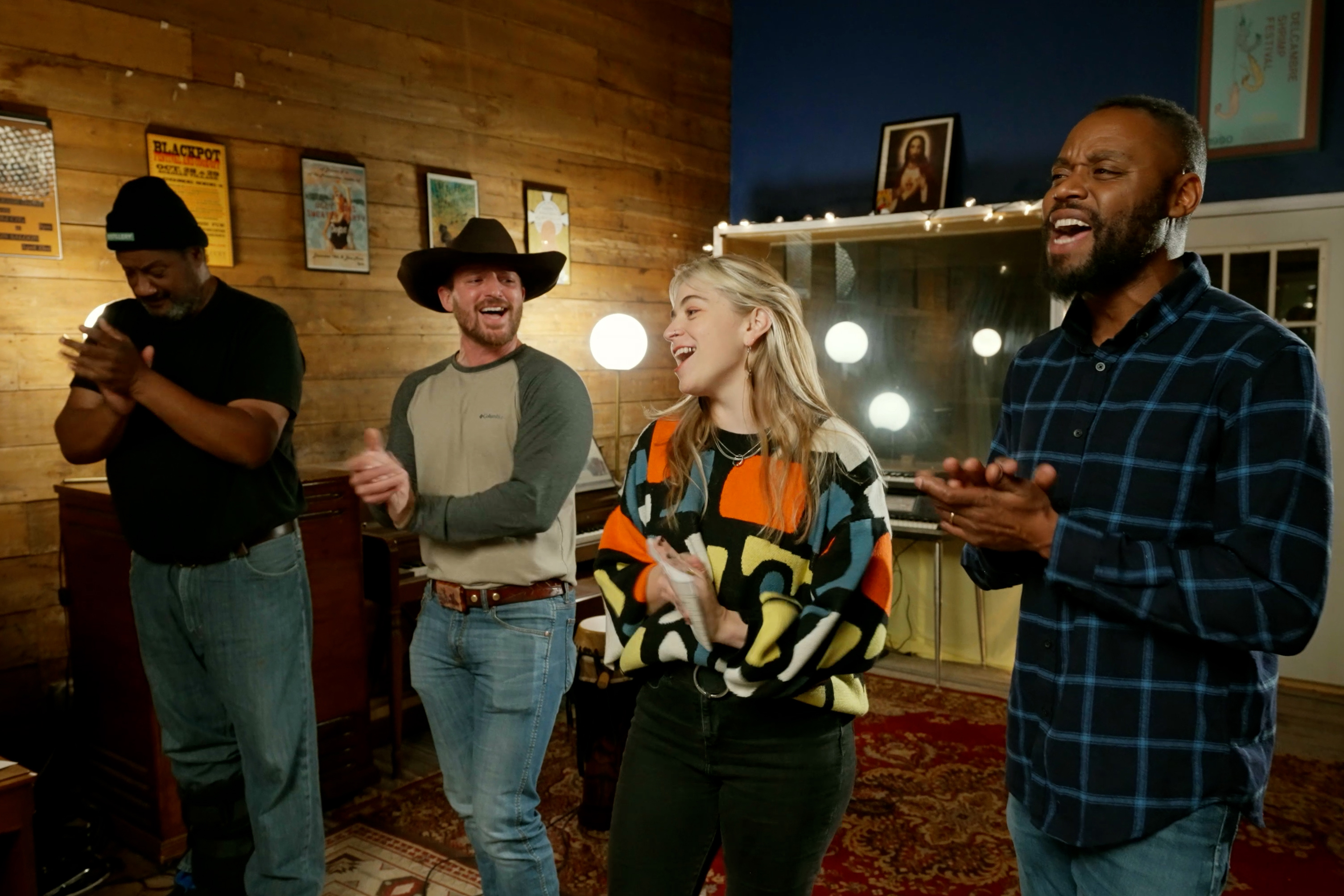
The Center for Louisiana Studies at the University of Louisiana at Lafayette will premiere a video series in collaboration with Lavoi Creative’s Roots of Fire at the October kickoff to Festivals Acadiens et Créoles.
Dry Bones brings contemporary musicians face-to-face with the Center’s archival collection of roots music. Chas Justus, an instructor in the University’s Traditional Music Program, serves as the host of the episodes. Each culminates with an original studio performance inspired by a song from the archives.
Dr. Joshua Caffery, Center for Louisiana Studies director, said the idea for the show came in the depths of the 2020 pandemic when donors reached out wanting to support a project for musicians, who at the time were not able to perform publicly.
Inspiration struck from — of all places — a 1990s British reality show called Time Team. Caffery said the show, which has more than 20 seasons, allows viewers to tag along as experts solve an archeological mystery together. He envisioned a similar concept, but for resurrecting buried Louisiana music.
The Center brought in Jeremey and Abby Lavoi, directors and producers behind Roots of Fire, a documentary about young musicians in Southwest Louisiana. The Lavois have never seen Time Team, but they do have experience with the Center’s archives.
“That's the north star of what Dry Bones is,” said Jeremey Lavoi. “It's a deeper exploration of the culture and the variety of art, music and stories that have come from South Louisiana that are accessible through the archives.”
The episodes feature the expertise of Louisiana music stewards: Dr. Barry Ancelet, professor emeritus of Francophone Studies in the Department of Modern Languages; Center for Louisiana Studies archivist Chris Segura; and the late Chris Stafford, songwriter, multi-instrumentalist and founding member of the band Feufollet.
Caffery said Stafford was involved as an engineer for the project before his death in 2024 and completing Dry Bones became a way to pay tribute to him. The team derived the title “Dry Bones” from an old spiritual featured on the first episode.
“It actually comes from the Bible, from Ezekiel,” said Caffery. “This idea of: ‘dry bones are going to rise again,’ and we thought, ‘oh, that's a cool metaphor.’”
The Lavois said they have more ideas of how to extend the project and hope to continue working on future seasons of Dry Bones — the creative work itself becoming a conduit to connecting the past with the future.
“It’s not your grandma teaching you, but it's a new way of passing on the songs,” said Abby Lavoi. “It's a modern-day extension of the vernacular culture.”
You can attend the premiere of Dry Bones at the Acadiana Center for the Arts on Oct. 8. Following the premiere, new episodes will be released on the Dry Bones site as a weekly web series through Wednesday, Dec. 9.
Artists featured in the project include Cedric Watson, Tiffany Lamson, Steve Riley, Peter Schwarz, Burke Riley, Megan Constantin and Kelli Jones, Thor Ahlgren, Nokosee Fields, Lisa LeBlanc, Joel Savoy and Linzay Young, The Williams Family, featuring Nathan Williams and the Zydeco Cha-Cha’s with Lil’ Nate and Naylan Williams, Sabine McCalla and Trey Boudreaux, and Feufollet with Julie Aubé. UL Lafayette College of the Arts graduate Camille Broussard created the title animation and logo for the project.
Dry Bones was made possible through support from Charlie and Lynne Terr, The Acadian Families Fund and The Sage Foundation. If you would like to support future seasons of Dry Bones, contact Dr. Joshua Caffery at josh.caffery@louisiana.edu. Gifts in support of the project may be made through the UL Lafayette Foundation.
Photo caption: Musicians Big Paul, Jourdan Thibodeaux, Tiffany “Teddy” Lamson and Cedric Watson perform during the first episode of Dry Bones, a new video series that pairs contemporary musicians with recordings from the Center for Louisiana Studies archives. The episode draws inspiration from “Dry Bones Gonna’ Rise Again,” a traditional spiritual recorded in Iberia Parish in 1934. (Photo courtesy of the Center for Louisiana Studies).
Dry Bones series breathes new life into archival Louisiana music
Published