
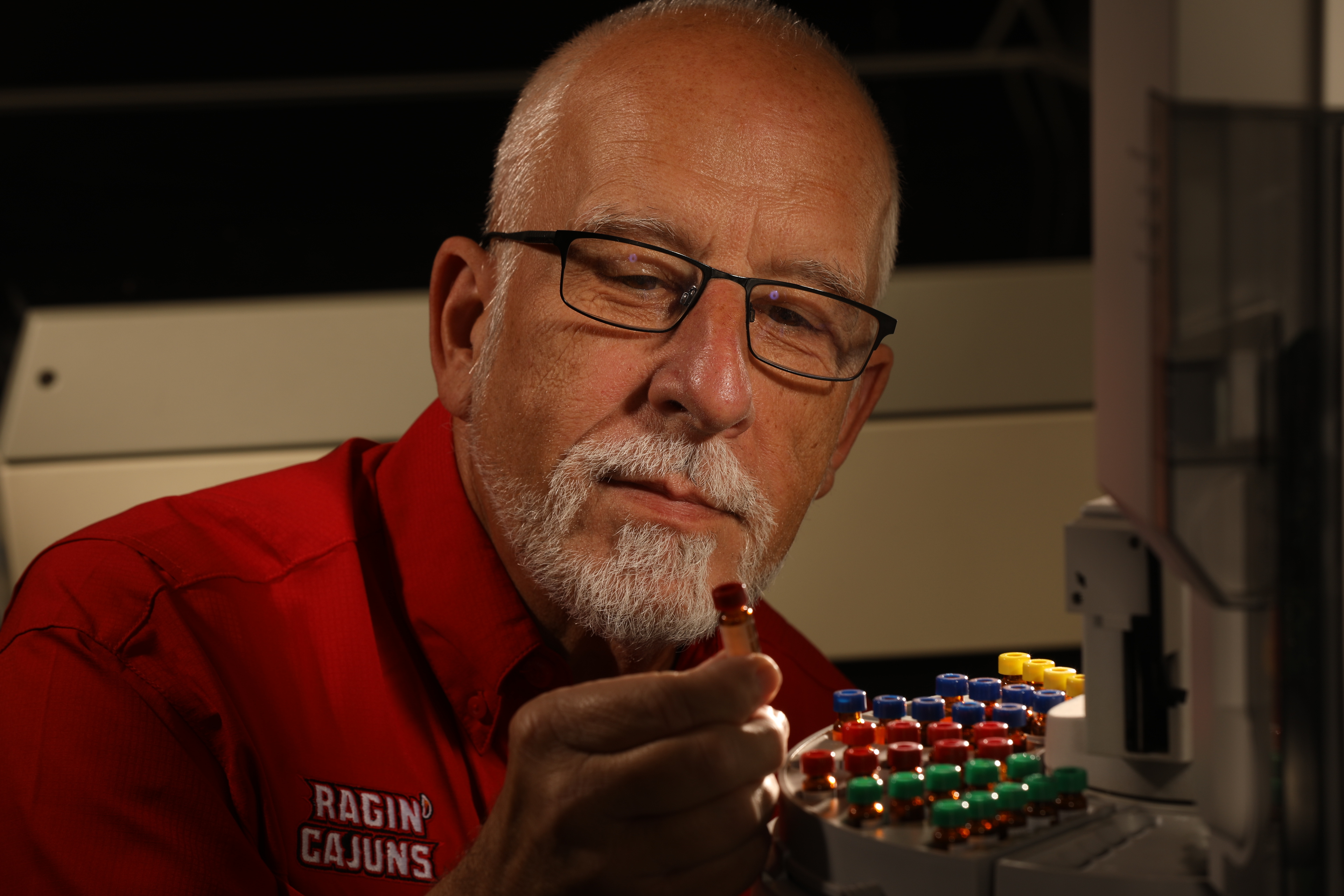
The University of Louisiana at Lafayette’s Dr. Karl Hasenstein has spent more than three decades researching ways to grow plants and vegetables in space, producing a body of work that’s informing longstanding efforts to colonize the moon and Mars.
As part of NASA-funded research, Hasenstein, a distinguished professor emeritus of biology in the Ray P. Authement College of Sciences, has sent several experiments to the International Space Station.
His studies have examined how plants growing inside artificial habitats sense and react to gravity in a weightless environment, how altered or reduced gravity affects plants’ growth and metabolism, and methods for producing vegetables for astronauts during long missions.
Hasenstein, who joined UL Lafayette in 1988, shows little sign of letting up. His latest research sheds light on how the lifeblood of any garden – water – would behave on the moon, which has a gravitational pull of about one-sixth of that on Earth.
Hasenstein conceived, designed and built a small, closed system structured to hold liquids and cameras to record how those liquids responded at lunar gravity as part of an initiative led by the company 4SPACE.
The experiment was ultimately launched past the internationally recognized boundary for space aboard a Blue Origin suborbital rocket system. Once in space, the rocket system’s capsule detached from the rocket, sending it – and Hasenstein’s experiment – into free fall, or a period of weightlessness, for about two minutes.
Post-flight, Hasenstein, with assistance from Florida Tech University’s John Z. Kiss and NASA’s Christopher P. McKay, comprehensively examined how the fluids – including water and water mixed with glycerol – behaved in those altered conditions.
The team determined that water doesn’t flow as freely at lunar gravity due to increased surface tension, providing insight into how farming and irrigation systems essential for colonization on the moon would need to be constructed and operated.
According to their findings, which were recently published in “Microgravity Science and Technology,” the scientists concluded: “Observing fluid behavior variability under altered acceleration is not only a novel experiment; the results emphasize the need to consider water flow and surface interaction as important part of future plant cultivation on the moon.”
Photo caption: From researching methods for seeding and growing radishes on the International Space Station to studying how water behaves on the moon, UL Lafayette’s Dr. Karl Hasenstein has spent more than three decades informing scientific efforts to colonize distant places. Photo credit: Doug Dugas / University of Louisiana at Lafayette