
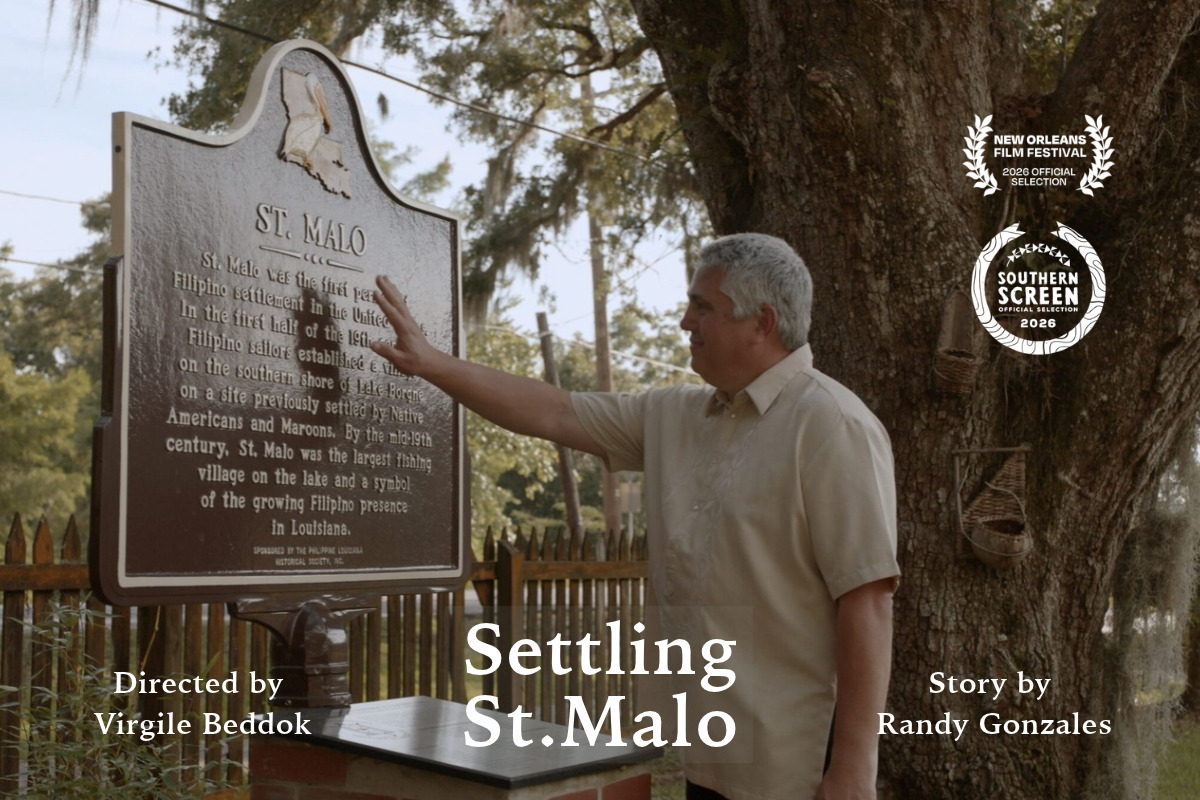
Dr. Randy Gonzales, an associate professor of English in the University of Louisiana at Lafayette’s College of Liberal Arts, blends heritage and history with his latest project, the documentary film “Settling St. Malo.”
The film recently premiered at the New Orleans Film Festival. A screening is scheduled for Saturday, Nov. 21, during the four-day 2026 Southern Screen Festival in Lafayette, La. The showing will happen as part of the festival’s Documentary Short Blocks event from noon to 2 p.m. at the Acadiana Center for the Arts, 101 W. Vermilion St.
The 26-minute film was directed by Virgile Beddock, an associate professor who leads the moving image arts program in UL Lafayette’s Department of English. Alumni and students also contributed to the film, including as actors and crew members.
“Settling St. Malo,” which Gonzales describes as a short poetic documentary, follows his award-winning poetry collection of the same name. The collection was published by UL Press in 2023.
Like the book, the screen version of “Settling St. Malo” delves into a subject near and dear to Gonzales, a New Orleanian of Filipino descent.
It follows the poet, writer and filmmaker as he learns about the history of his ancestors while telling a broader story of nineteenth- and early twentieth-century Louisiana, when the state had the largest Filipino population in the U.S.
The documentary – which is driven by poetry and includes narrative, archival footage, and reenactments – begins in 1930s New Orleans, where Gonzales discovers that his great-grandfather was a leader in the city’s Filipino community.
It carries to coastal fishing communities like St. Malo, the first Filipino settlement in Louisiana and the country’s oldest Asian settlement. The village, about 5 miles from New Orleans on Lake Borgne in St. Bernard Parish, was wiped out by storms in the early 20th century.
Gonzales revisits the remote marshland where the village once stood and other places to capture what life was like for many of Louisiana’s earliest immigrants from the Philippines, a “forgotten” story, even to him.
“We basically start with the idea that I didn’t know this history – and I grew up in Louisiana – and go about uncovering this personal story. Then we go backwards and St. Malo is the end point of this historical journey, this long history of Filipinos in Louisiana,” he explained.
Gonzales pieced together the film -– like the collection of poetry that preceded it – with purpose.
It signals the latest chapter in his longstanding work to fill in gaps where little recorded documentation about Filipino migration and settlement in Louisiana exists. As he explains in the film: “This story continues to be written.”
Gonzales is doing his part.
Beyond his book and film projects, he’s a renowned researcher and scholar on the history of Filipinos in Louisiana. Reporters for the British Broadcasting Corporation, CNN, the HuffPost and other outlets, including major networks in the Philippines, routinely lean on Gonzales’ expertise for in-depth coverage of the Filipino diaspora.
Outreach is also important to him. As the former co-vice president of the Philippine-Louisiana Historical Society, Gonzales played an integral role in securing state approval for a historical marker that commemorates St. Malo. He also wrote text for the marker.
“For me, it’s been a multi-pronged approach to getting the word out with this primary mission of making sure that when people look out across Louisiana, they remember Filipinos were here early, too – not just Cajuns, or Creoles, or French, but Chinese, and Croatian, and Haitian. It was a mix. New Orleans is multicultural, but people are hard pressed to name the cultures beyond a handful,” he said.
Gonzales is currently at work on a book – “Adobo at Gumbo: Savoring the Culinary History and Food Culture of Filipino Louisiana” – that will be published by LSU Press. At its core, the text will address how and why Filipino settlers were able to so readily thrive along Louisiana’s rugged coast.
“It’s about the foodways of those early settlers, what they were eating in places like St. Malo. Basically, how they brought indigenous Filipino cooking methods to prepare seafood. It allowed them to live more easily in the wetlands than, say, European settlers from landlocked areas who didn’t have those traditions and knowledge,” he explained.
Photo caption: “Settling St. Malo,” a documentary film by UL Lafayette’s Dr. Randy Gonzales, captures a time when Louisiana had the largest Filipino population in the U.S., including in the tiny coastal fishing village of the film’s title. It will be screened on Saturday, Nov. 21, at the Acadiana Center for the Arts. Photo credit: Submitted photo