
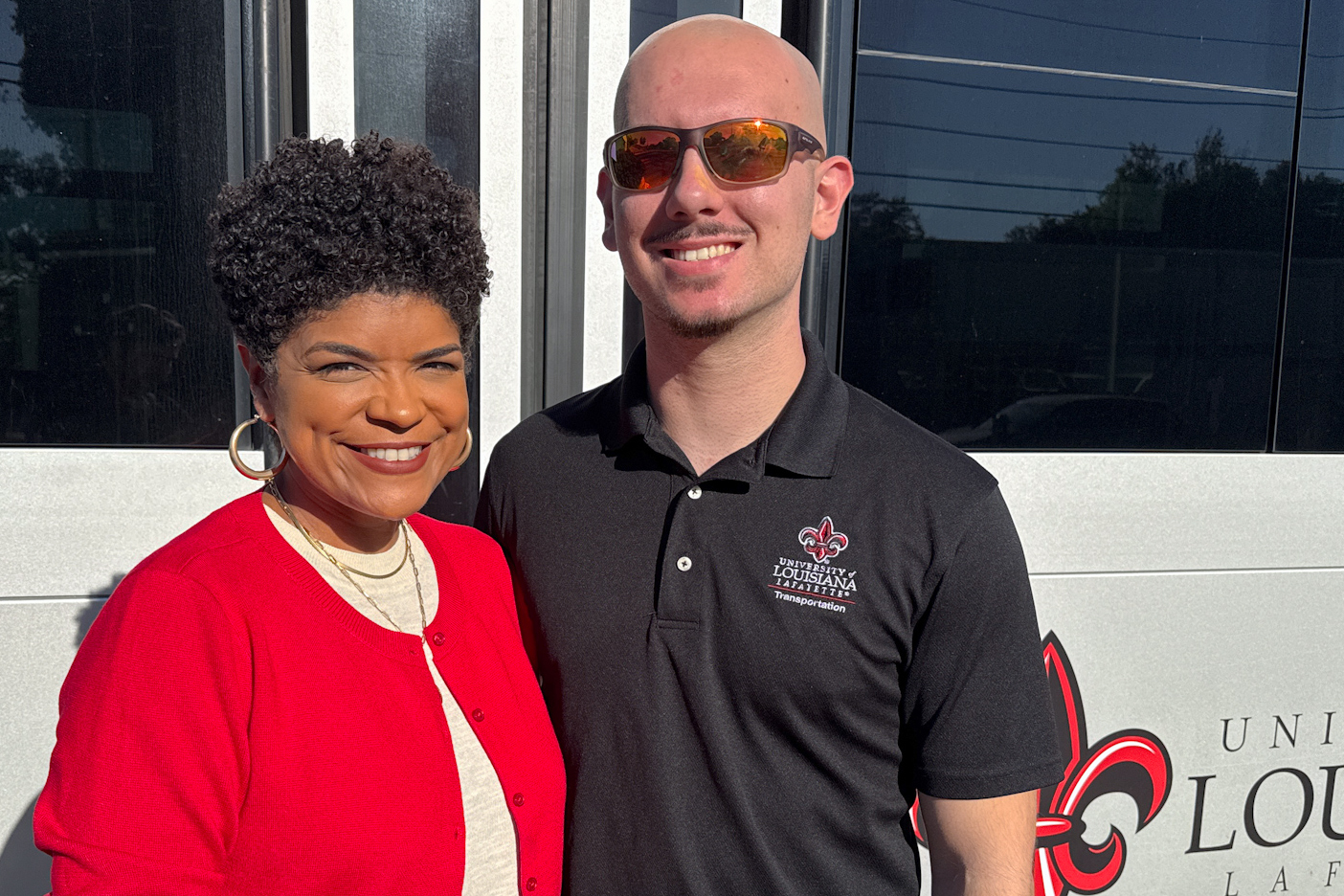
When Connor Bergeron arrived at the University of Louisiana at Lafayette, he never imagined he'd spend much of his college career behind the wheel of a bus. Now a senior majoring in mass communications, he's transported thousands of fellow students across campus, met people from all walks of life and discovered a possible career path he hadn't considered.
In the latest episode of the La Louisiane Podcast, Bergeron joins host Marcelle Fontenot to talk about his unexpected journey as a student bus driver, the opportunities his job has opened up and the experiences that have shaped his time at UL Lafayette.
For Bergeron, the University has been part of his life since childhood. His mother, a UL Lafayette alumna, would bring him to campus to see the bricks along the Walk of Honor. Those visits helped him envision his own future here. Now, as graduation approaches, he looks forward to the day he can return with his family to find a brick bearing his own name.
Watch the conversation on YouTube or read the edited transcript below.
Marcelle Fontenot: Connor, thank you for joining us for this conversation. We'll get to your major and your status as a senior, but let's talk about why we're on this bus. What is your job here at UL?
Connor Bergeron: Pretty much what we do on a daily basis is get students from point A to point B. There's not enough parking on campus, so people park at the field, and we take them to get to their classes on time.
Marcelle Fontenot: Connor is a University bus driver, not something you hear every day as a student job. How did this come about?
Connor Bergeron: That was what surprised me when I first got here. I didn't even know this was offered to students. I was just scrolling through my options, looking for a job, and I see the option "bus driver" pop up. I'm thinking, there's no way, right? This has to be something I'm not qualified for. But I emailed the contact, and here I am.
I came in with no bus driving experience, barely any driving experience. But they trained me, they got me right, and here I am now. Year four of driving.
Marcelle Fontenot: It's one thing to drive your car; it's another thing to drive a bus. What was your training like?
Connor Bergeron: The funny thing is, once you get it down, it's no different. When you're a kid, you drive a bike, and driving a car is very different from driving a bike. But once you get a sense for the spacing, the ways you have to turn and where you can fit, once you have that locked in your head, it's just as easy as riding a bike, just as easy as driving a car, as long as you pay attention to everything you need to pay attention to.
Marcelle Fontenot: One of your responsibilities is getting students where they need to be as they're starting or ending their day on campus. What sense of responsibility do you feel?
Connor Bergeron: It kind of goes unthought about for the most part. We just show up and do our job every day, but I think we have a pretty important job. There's a big function of the University that I think isn't able to work as well as it does if we're not on our A game every day, getting students where they need to be.
So it's an honor, it's a privilege, but it's something that anybody can do if they have the right mindset and they're willing to do what they need to do.
Marcelle Fontenot: Let's talk about the students who ride your bus. What kinds of experiences have you had with them?
Connor Bergeron: It can be pretty cool. You're never lacking for a fun story or something interesting happening during the day. It could be as simple as somebody not saying a word and just trying to get to where they're going, or maybe they're feeling extra sociable today and they'll come talk to you, ask you how your day is going. So, from all sorts of different interactions, we pretty much see it all over here.
Marcelle Fontenot: Has this job introduced you to people you might not otherwise have met during your college experience?
Connor Bergeron: Definitely not. I'm a little more introverted whenever I'm not at work. I don't think there's any way I would ever be exposed to so many different people if it wasn't for this job. And it's been cool. There's definitely been some things that I probably never would have found out about myself if not for this job, from being able to compare myself to so many different people.
Marcelle Fontenot: This job has taken you out of your comfort zone and broadened your horizons. Let's talk about your student experience. You're in your final semester. What were your expectations as a freshman, and how have they changed over the past four years?
Connor Bergeron: When I first showed up, my parents wanted me to make it a point not to work my first semester, to get my feet wet and get settled into the feel of college and the way it works around here before I started working, which was something I definitely didn't take for granted. The ability to have my parents say, "Look, you're good for this semester. Just settle in and…"
Marcelle Fontenot: "Figure it out."
Connor Bergeron: Exactly. But after that first semester, that's when things got rolling.
One of the great things about this job is how much they cater to students. It's a student job. They understand the importance of students being in school and focusing on their academics.
I could sit here all day, and I probably couldn't think of one complaint I've had with this place as far as working around my school schedule and studying, that kind of thing. It's been great.
You wouldn't think a job with so much to do would be so willing to be give-and-take and cater to that. But that's something I've always appreciated about this job, how much they're willing to stand up for their student employees and make sure they're focused on graduation, which is the main goal.
Marcelle Fontenot: That is absolutely the main goal. What advice would you give an incoming student or a freshman who's just starting to explore opportunities at the University?
Connor Bergeron: The best advice I'd probably say is, "What do you have to lose?" You can only learn more about yourself. You can only find out about new things that you didn't know you loved as much as you did. You never would have come into contact with them if you don't see what's out there.
I think that's the best way to learn about yourself, by looking in a mirror, but also looking out at everything else around you and saying, OK, how do I fit into this niche, or is this really my thing? Well, you have to go see before you can make that decision for yourself.
Marcelle Fontenot: How has the University given you the space to do that?
Connor Bergeron: It starts with the buses. I think there's a lot of things that we do with the buses. It's not just sitting behind a wheel and driving in a circle every day, right?
There's a lot of other opportunities, as far as meeting people in parking and meeting people in different areas of the University, where you're allowed to see things from different perspectives, but also take a look back and see it from the whole University perspective as well.
Marcelle Fontenot: The University is a microcosm of society, and you've experienced that firsthand as a bus driver. You're about to graduate. How does that feel?
Connor Bergeron: It's been a long time coming. There's been a few moments where it looked a little tight, but it looks like it'll work out.
Marcelle Fontenot: What will you miss most about college life?
Connor Bergeron: Honestly, I think it's the people. Not only friends and coworkers, but even just passing somebody on the sidewalk. Even if you don't talk to them directly, you gain so much.
There's so many interesting things to see just from being around so many different people on campus, and it's something I don't necessarily think you would get outside of a university setting, where there's so many different people all here for the same goal.
It's an interesting way to see what's out there over and over again. You're all there for a reason, but you're also all on your own part of the journey, and so it's cool to look and see where other people are at and kind of…
Marcelle Fontenot: Figure it out.
Connor Bergeron: Figure it out, exactly.
Marcelle Fontenot: You could have gone anywhere. What made UL stand out, and why did you choose to come here?
Connor Bergeron: Even since childhood, this was kind of the one. There's always LSU. Everybody wants to go to LSU, but my mom went to UL.
Every time we were in town for a doctor's appointment, whatever it may be, she'd say, "Oh, let's go drive by campus and see the bricks, see the bricks on the Walk of Honor," and that kind of thing.
Even though coming in as a freshman was my first time really being on campus and exploring it for myself, I always had UL, even from childhood, as something that I knew, OK, this is a good place to be. This is where my mom went, and it's a place that would be good for me.
Marcelle Fontenot: Graduation is coming up. What are your plans afterward?
Connor Bergeron: Honestly, I think this job has shown me opportunities for CDL driving outside of just bus driving. There's truck driving and that kind of thing.
This job made me realize that this is something I might want to do for a living. There's always options out there for truck driving, and I think that might be something I'd like to keep an eye out for.
Marcelle Fontenot: That's fantastic. Truck drivers are a major facet in how things get done and how we get the goods that we need all across this country.
Connor Bergeron: Yes, ma'am.
Marcelle Fontenot: It's interesting that a job you never really had your eye on is now leading you toward what you may do in the future.
Connor Bergeron: Right, I credit that to the University. Even after I applied and got a response, I walked into my interview thinking, OK, someone has to come out from behind the door and tell me this is a prank show. I can't really be about to learn how to drive a bus. That's something other people do.
But they meet you where you're at and train you until you're ready. It's that simple. There's nothing you need to come in knowing, as long as you're willing to take in the information they're giving you and telling you what you need to know. And it's worked out so far.
Marcelle Fontenot: We've talked about how this job has shaped your college experience. Let's talk about the transportation services available to students. Beyond getting students from parking areas to their classes, what else is offered?
Connor Bergeron: First thing students usually do in the morning, if they're commuting, they pull up to the field and take a bus back to campus. It also stops at the gym, so if you're trying to get to the gym, you would get on that bus.
Then there's the main campus shuttle that takes you around all the different points on campus. Between Heritage and Legacy Apartments, the Café Fleur de Lis, the Student Union, all kind of meeting together at that central point in front of the Conference Center, Agnes Edwards. I think there's nowhere on campus that you can't get to.
Marcelle Fontenot: What about off-campus transportation?
Connor Bergeron: We definitely have different things. On Fridays we have the shopper shuttle that takes you to Walmart if you need to go grocery shopping.
We have different events. If there's a summer camp, we're in charge of that. Tomorrow, we actually have a preview day for incoming freshmen, taking them around campus, and that'll be our job on the bus, to take them where they're going. So, yeah, there's options.
Marcelle Fontenot: Transportation Services provides a lot of options for students. Can you give us a sense of how many students use those services?
Connor Bergeron: It gets crazy when you really stop and look at it. Usually, we're just in that mode of getting the job done, doing what needs to be done.
But on the bus we move multiple thousands every day, probably upwards of 4,000, just in one day alone. Then you add that over a whole week, and we're moving a lot of people.
Even the shuttle, less numbers, obviously, it's not a full-size bus, but that's in the hundreds, too, of people going to the union for lunch, to Starbucks, whatever the case may be, and then bringing them back. So it's definitely something I think the students take advantage of.
Marcelle Fontenot: It's certainly a valuable service. Beyond driving, what other responsibilities do student bus drivers have?
Connor Bergeron: We work a lot with parking. They just had Festival Acadiens down the road, and the bus drivers helped out with taking payments for parking. We have alumni events where we drive alumni where they need to go. I mean, we have…
Marcelle Fontenot: Who cleans these vehicles? Do y'all take part?
Connor Bergeron: That's also us. That's a summer job for us. We cut down in the summer. We don't have as many buses running during the summer, so any driver who wants to come get some hours can come scrub a bus for the day when it's nice and hot outside. So it can be fun. I enjoy it.
Marcelle Fontenot: You're doing more than driving. You're helping maintain the service, too. Tell me about someone you've met or something you've experienced that you'll carry with you beyond graduation.
Connor Bergeron: It's really hard to pick one. In a way, you get used to it, and you don't even realize the interesting things that happen sometimes because you see it so much.
Marcelle Fontenot: Are there students you've driven regularly over the years who have made an impression on you?
Connor Bergeron: We definitely have regulars. I've made a couple of friends on the buses. I wouldn't necessarily say best friends I keep in contact with every day, but you see someone walking by that you picked up, that you drove that morning, and it's a wave, "Hey, how you doing?" That kind of thing.
So that part of it's cool. It goes back to being exposed to a lot of new people. I probably would have just been walking straight to class and not thought anything of it. But you see a familiar face, and it can brighten your day up a little bit. So that's been cool.
Marcelle Fontenot: You've mentioned visiting campus with your mother as a child and seeing the bricks along the Walk of Honor. What will it be like when you have your own?
Connor Bergeron: It'll be surreal. I'd love to take my little siblings and maybe future kids one day and see my brick, and do the same thing.
My parents were, and still are, a very integral part of how I was raised, obviously, and I hope to do as good a job as they did.
Marcelle Fontenot: The University's culture and traditions, including the Walk of Honor, are part of what makes UL Lafayette distinctive. How do you think those traditions shape the student experience?
Connor Bergeron: It's major, it's massive. I think that's part of the appeal of coming here. You get to be a part of such a great culture and one with so many traditions that you don't get everywhere else.
We have a great football culture, a great sports culture, but also music. There's always music playing on campus. We have the Hilliard Museum right next to campus. There's art there, so it's great.
Being a part of it grounds you more in where you're at. It makes you feel like you're a part of something that's bigger than yourself, and I think that aspect would be a great draw to anyone looking for a unique college experience.
Marcelle Fontenot: It's definitely a unique place. Students come here for an education, but they also become part of a community. If another student is considering becoming a bus driver, what advice would you give them?
Connor Bergeron: That's the first step. You have to think that it's something you could do. We're always hiring. It's a job that I think is not for everyone. But if you think it's for you, then I think you're the right person for it.
Like I said earlier, there's nothing you should come in feeling like, "Oh, I can't do it because I don't have this experience," or "I don't know much about this."
There's nothing they can't teach you here. The training was great for me, and it's been great for the new drivers I've seen come along the way. I think they should go for it if it's something they're interested in. We always need the help.
Marcelle Fontenot: What's it like when new drivers come? Are they nervous?
Connor Bergeron: It's funny. They don't look as nervous as I was. That's the first thing I notice. I always feel like I was more nervous than some of these new guys are.
But they pick it up. It's kind of a crazy thing. You see new people come in and they always pick it up, and then within a few weeks they're just one of the guys. So it's cool. I think that's a credit to the way they train new drivers here.
Marcelle Fontenot: I don't know, Connor. I'd be highly intimidated on my first day of driving a bus. But hearing about your experience and the opportunities it's opened up for you shows how stepping outside your comfort zone can lead to new possibilities. Connor, thank you for joining us.
Connor Bergeron: Thank you.
Marcelle Fontenot: We truly appreciate it.