
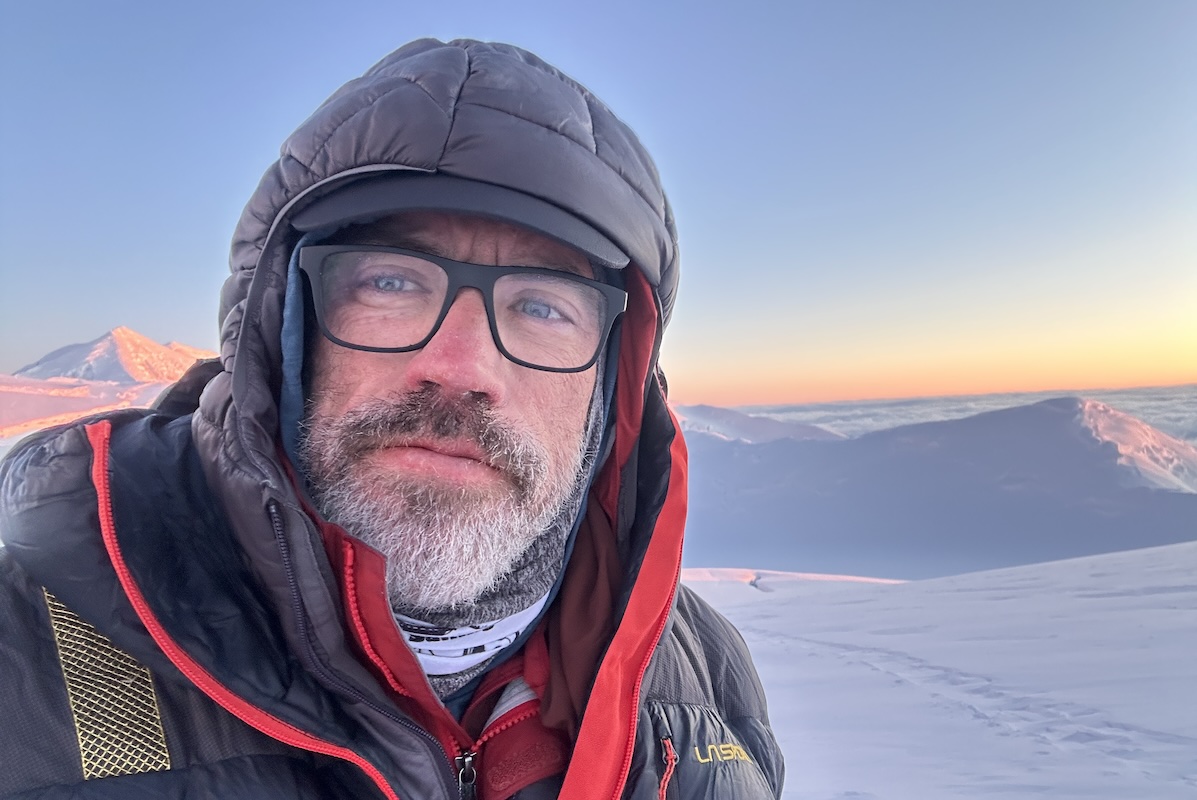
Dr. Linus Wilson recently made headlines for climbing Mount McKinley in Alaska’s Denali National Park, the highest peak in North America. This achievement completed his quest to summit the highest natural elevations in all 50 states, known in the climbing world as the “high points.”
Wilson has been a professor of finance at the University of Louisiana at Lafayette B.I. Moody College of Business Administration for the past 19 years, teaching international finance and an advanced course on corporate finance.
La Louisiane spoke to Wilson as he climbed the highest and most daunting elevation on UL Lafayette’s campus — Mount Griffin.
How did you get into mountain climbing?
I didn't really get into mountain climbing until after I got into sailing. I was listening to a lot of audio books about sailing, and I ran out of audio books for sailing, so I started listening to narratives of mountain climbers.
What was the most memorable moment from that most recent climb in Denali?
There was the time when I slipped at 18,500 feet at Denali Pass because I went to the wrong entrance, and I was able to self-arrest with this ice ax. I also had an ice tool and was able to climb the ice. My crampons were not really sticking in the ice because it was so hard, but I was able to climb back to the rocks and kind of reassess up.
Wow, so we live in South Louisiana. How do you train for something like this when the highest nearby point is the fifth floor of Griffin Hall?
I have a kind of a long history as a distance runner, so I mean I think there was a period from 2014 to 2023 that I ran every day, and I've run three marathons and maybe over 100 5Ks, so I think I had that base of endurance most recently for Denali. I think the weight training I've been doing for the bodybuilding I've been training for helped a lot, because there are no porters on Denali, and there was so much I had to carry. For that mountain, I think the strength was probably more important than the endurance. I also do altitude training, so I use a hypoxic tent that sucks the oxygen out of the air and puts nitrogen instead, and so I was in that tent for like 400 hours prior to Denali to prepare for the altitude.
I think one of the mistakes that people make when they come from a cardio background or a running background is that they want to race up the mountain, and the really the best way to do it is to do what the Tanzanians do, so their phrase is “pole, pole,” or “slowly, slowly." So, the slower you go up the mountain, the more success you're going to have, because you allow your body time to acclimatize.
When did you start this adventure to climb to the highest mountain in every state?
I started it in 2021 after COVID. I had a boat that was in the South Pacific, and in this island, the overseas territory of New Caledonia, which is kind of close to Australia. It's part of France, and I couldn't get back there because of COVID restrictions. So, bought a 14-foot travel trailer, and I was visiting Mount Rushmore. Near Mount Rushmore is the high point of South Dakota, which is called Harney Peak or Black Elk Peak, and took me three times to climb it.
So, you learned from that experience. And you mentioned earlier that you listen to audio books while you train. What do you like to listen to?
I used to really like to listen to travel narratives of sailors and mountain climbers, and you know, I've written a few travel narratives myself.
What are they about?
There's one, it's called “Slow Boat to the Bahamas,” and the other is called “Slow Boat to Cuba,” and they're about my trips to the Bahamas and Cuba. And then another one's called “Covid Road Trip” and “RV Adventure” that talks about the climb of my first high point.
What's your favorite adventure to have here in Louisiana?
I think Chicot State (Park) is a pretty nice place if you want to do kind of like backpacking, there's a lot of primitive campsites you can go to. There are a lot of hiking trails there, so that could keep you busy for a while.
How does this work as an endurance athlete and a climber impact and influence your research and teaching?
I have been doing some research on both the seasonality of Denali and also the 50 state high points. But in terms of the students, I don't talk about my mountain climbing in class.
But is there any advice from these experiences that you try to instill in your students?
Show up, show up. Do the work, and good things are going to happen. In terms of the mountain, you show up and you stick it out until it's done.
What's your favorite class to teach?
I prefer financial problems analysis. That's my favorite class to teach here.
What do you cover in that course?
Advanced concepts in corporate finance.
I bet that gets interesting.
Yeah, so we go through things like cost of capital and capital structure and the debt equity mix, that type of thing.
What’s the ROI on a climb up Mount McKinley?
Negative, very negative. I mean, that's the nice thing about climbs, you have that great experience in the moment. You remember it forever, regardless of which one it is, but you know, in terms of money, no. But in terms of experience, yeah.
Alright, so you've climbed the highest point in all 50 states, you've sailed across the Pacific. What's your next challenge?
I'll probably go back to Aconcagua. I tried to climb it in 2023, and I turned around at about 19,000 feet. I think I'm better prepared this time, so hopefully it'll work out. That's the highest mountain in South America — the highest mountain outside of Asia. It's in Argentina.
Anything else that you'd like to share with the campus community?
I think UL Lafayette is a great place to be. Lafayette is a great town to be in, so many opportunities, so many fun things to do. Take advantage of this University. It has a lot to offer.
You can follow Wilson's adventures on his YouTube channel, Slow Boat Sailing.
Photo caption: Dr. Linus Wilson recently summited Mount McKinley, the final peak of his 50 states high point challenge. Photo credit: Courtesy of Dr. Linus Wilson Video credit: Kade Parker / University of Louisiana at Lafayette
This story is part of La Louisiane, the official magazine of the University of Louisiana at Lafayette. Published since 1989, La Louisiane covers the University's research, students, faculty, alumni and Louisiana culture. La Louisiane is an award-winning publication recognized by the Council for the Advancement and Support of Education (CASE).