Few student research projects risk being taken down by an interceptor drone. Then again, few students get chosen by the U.S. Department of Defense to develop technologies for military use.
That was the assignment for the Ragin’ Cajuns Drone Team from the College of Engineering at the University of Louisiana at Lafayette as part of the DARPA Lift Challenge.
The eight-day event was coordinated by the DOD’s Defense Advanced Research Projects Agency, or DARPA. It was held earlier this month at the National Museum of the U.S. Air Force in Dayton, Ohio.
The Department of Defense is evaluating methods for enhancing the lift capabilities of drones, which can currently only safely and effectively hoist and fly with payloads roughly equal to their own weight.
Almost 500 prospective teams sent proposals seeking entry into the challenge, with 132 teams from 30 states and 25 countries making the cut. Many of those teams were unable to engineer a drone capable of passing the challenge’s defining test – lifting a payload at least twice its weight.
The Ragin’ Cajuns Drone Team – mechanical engineering majors Collin Faucheux, Andres Gonzalez, Logan Leger, Logan Livaudais and Cameron Strother – wasn’t among them. The Department of Mechanical Engineering’s John Carroll, an instructor, Yasmeen Qudsi, a senior instructor, and Dr. Jonathan Raush, an associate professor, advised the students.
The team’s strong showing came against an elite, international field representing industry, academia and government. “It was a high-pressure situation, and the students handled it remarkably,” Carroll said. “There was a lot of aerospace and engineering expertise out there.”
Carroll’s assessment is supported by information on DARPA’s website. It reads: “Participants played a critical role in advancing vertical lift technologies that will have far-reaching benefits for military missions and civilian needs.” Stephen Winchell, director of DARPA, agreed, describing “the Lift Challenge drones' lifting ability as better than what’s in the market today.”
It’s a statement with merit, if the prize money awarded at the conclusion of the event is any indication. Six teams were awarded a total of $4 million. The lion’s share went to the first-place finisher, a small business team from Columbia, Maryland, whose performance brought a $1.25 million payout.
The Lift Challenge’s guidelines were straightforward. Meeting them was more difficult.
Drones had to weigh 55 pounds or less and be designed to take off and ascend vertically while carrying at least double their weight. Controllers on the ground had to fly the drones for 4 nautical miles, land them to deposit the payloads and send them up again to fly one more nautical mile.
Those flights happened during head-to-head performance trials inside 1,100-foot-long, 100-foot-wide “lanes” spaced 50 feet apart. With plenty to go wrong, no failure loomed as large as straying above a Federal Aviation Administration-mandated ceiling of 200 feet. Those breaches triggered the launch of an interceptor drone, which was scrambled into position to take out rogue drones if necessary.
“It was deployed regularly, but if operators could quickly give a command that they were in control of their aircraft, it wouldn’t be shot down. And none were,” Carroll explained.
Crashes, however, were frequent. But not unexpected. “The idea was to push your system to the limit. Pretty much every single team crashed. So, you crash, go to a hangar to fix it and make adjustments, and try again. Unless, of course, the crash was catastrophic,” he added.
The Ragin’ Cajuns Drone Team’s spot in the challenge – and eventual standing among the top- performing aircraft – began in February. Students’ comprehensive research in areas such as aerodynamics, propulsion, materials and systems integration led to months of manufacturing work in University workshops and laboratories.
By this summer, the students were meeting up to five days a week to get their project finished and airworthy.
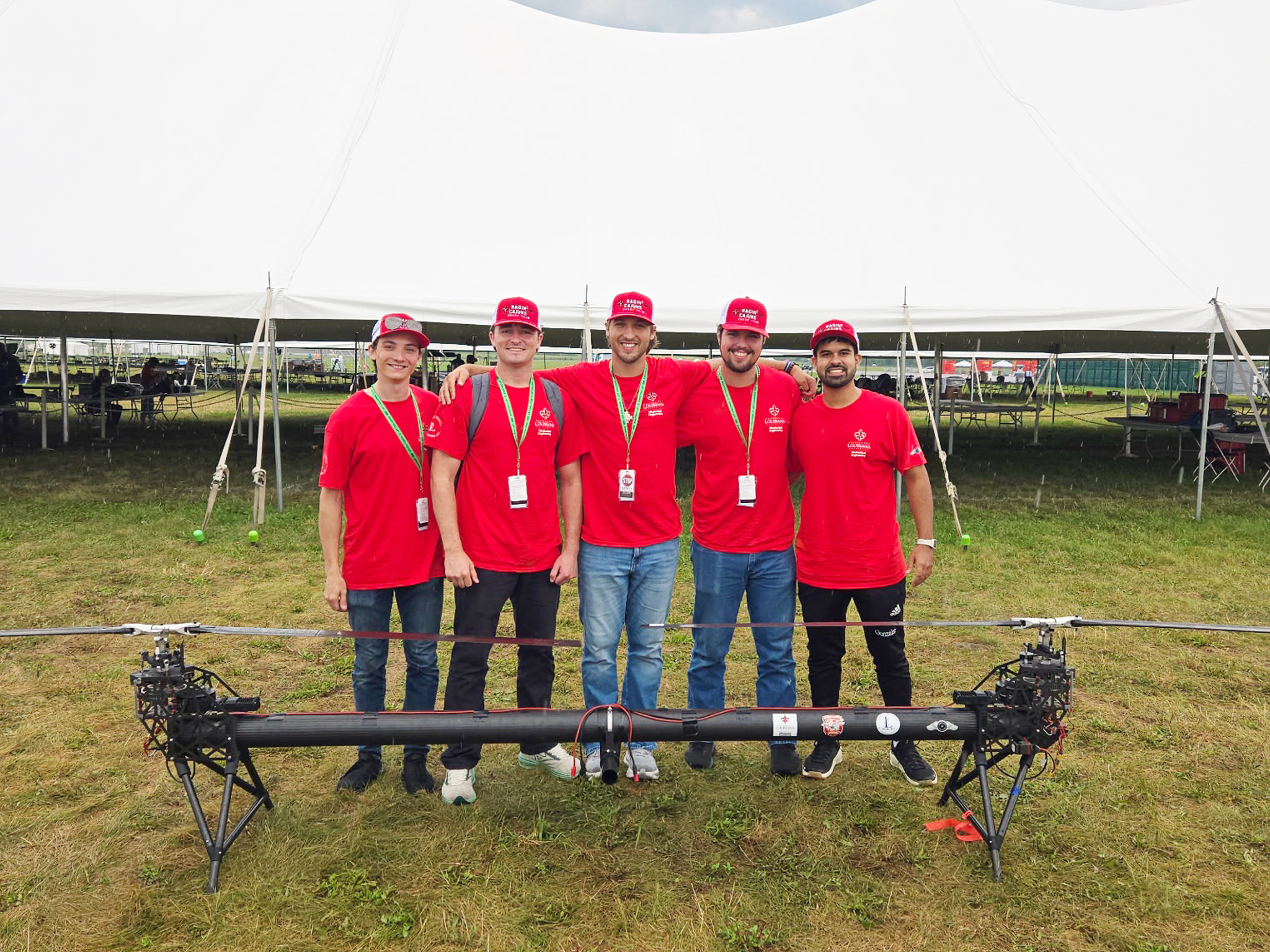
They created a 44-pound drone modeled on a Chinook helicopter that was made largely of carbon fiber materials. It was 17 feet long, with a 10-foot-body and large tandem rotors at each end to facilitate strong vertical-lift capabilities.
The team tested and tweaked their drone almost right up to the day they traveled to the competition. Their hard work paid off.
“We were excited that we showed up to competition with a flying aircraft. There were teams that couldn’t get their machine off the ground,” said Logan Livaudais, the Ragin’ Cajuns Drone Team’s student pilot. “And here we are, UL mechanical engineering students, competing against some of the world’s best aerospace companies and technical universities.”
Photo caption: A team of UL Lafayette mechanical engineering majors engineered and built an innovative drone that placed them among a select group of top performers at a recent event coordinated by the U.S. Department of Defense. Members of the Ragin’ Cajuns Drone Team, from left to right, are: Logan Livaudais, Logan Leger, Collin Faucheux, Cameron Strother and Andres Gonzalez. Photo credit: Submitted photo
Ragin’ Cajuns Drone Team flies high with U.S. Department of Defense project
Published