
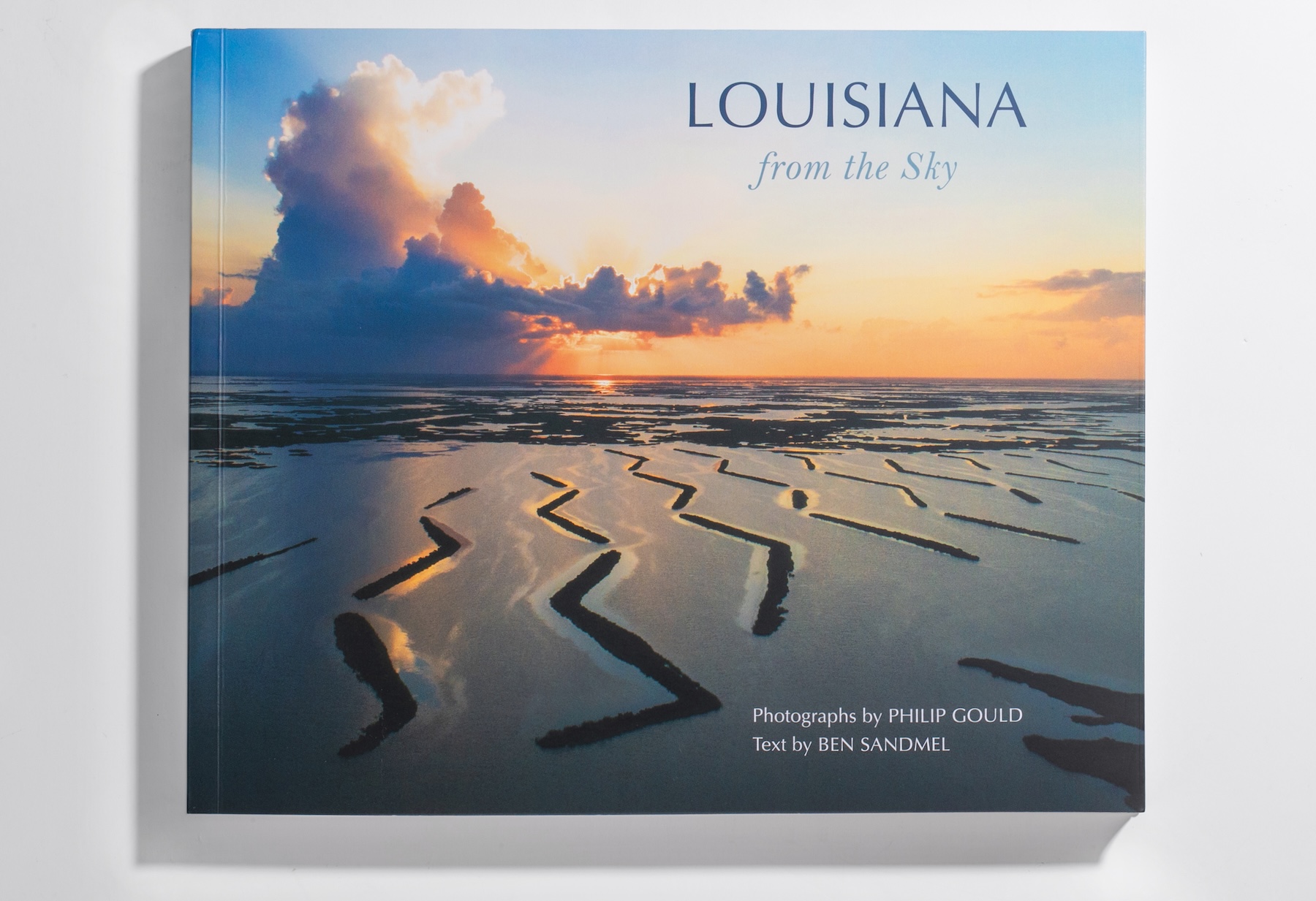
Photographer Philip Gould joined La Louisiane for a conversation about his 20th photography book, Louisiana from the Sky, published by UL Press.
In this podcast episode, Gould discussed how aerial and drone photography offered a new perspective on a state he has documented for decades. Using what he describes as a "tripod in the sky," Gould captured bird’s-eye views of Louisiana — from small-town festivals and familiar landmarks to rarely seen perspectives of swamps, prairies and urban landscapes.
Gould, who has photographed Louisiana since the 1970s, reflected on how this project differs from his previous work, why the state continues to surprise him and what he hopes people will take away from this collection of images.
You can listen to the conversation with Gould and La Louisiane managing editor Marie Elizabeth Oliver on KRVS 88.7 FM, watch on the University of Louisiana at Lafayette’s YouTube channel or read an edited transcript below.
Marie Elizabeth Oliver
I know you've been taking photos of Louisiana since the '70s. How is this book different? How is this approach different?
Philip Gould
That's a good question. I've taken — I've been taking photographs since the '70s, when I first came here in '74 working for The Daily Iberian, straight out of college, and just for the record, it was the best first newspaper job one could hope for. It was just amazing. I got to do whatever I wanted. No news really, in this town. So, the newspaper was looking for other things, and so, "go beat the bushes." And that's kind of how I did it. And I learned to see opportunities where, apparently, you know, none may have been obvious.
To get to your point, the orientation for most of my work up until this book, has been from the ground. It has been looking straight at whatever the subject is. And the previous book I did on bridges across the Mississippi, I used a drone on many occasions. You need the drone for the perspective looking at the bridges, and then I just transferred it. There's a photograph in the book a couple of days before Christmas Eve where you have this wooden alligator, huge 30-foot alligator, all these people are gathered around it, and you see the tops of their heads and long shadows that they're casting. And that was the picture that triggered the idea. That if this strange, surreal scene just pops right up. I'll bet you others will, too.
Marie Elizabeth Oliver
OK, so the photo came first and then the idea for the book. Wow.
Philip Gould
The photo triggered the idea. Absolutely, and so at that point, I just kept my eyes peeled, kept thinking about what could make a good photograph. There were a ton of obvious subjects that needed to be covered, you know, the French Quarter, the Mississippi River, the prairies, and also just the landmarks, you know, the cities that people built in this very, somewhat flat terrain. And I think those have a lot of interest as well. You know, I photographed New Iberia, Abbeville. I photographed Minden, Louisiana. I photographed Shreveport, photographed in Alexandria, Cane River. I mean just different places where the hand of man was utilized to create — the architecture for culture. I enjoyed that.
Marie Elizabeth Oliver
It's just a totally different perspective. And I liked how you mentioned at the beginning of the book about how being from California, you were kind of used to the different topography, and it's so flat here. We don't often see the drama in that way.
Philip Gould
I came to Louisiana at the age of 22 from California, geographically spoiled. I mean, every time I turn around, there's amazing view of the Pacific Ocean or the Bay. I get to Louisiana, and it's flat, flatter than this table, and so finally I realized that the verticality came from standing under live oaks, and that you get that overhead canopy, which helped.
Marie Elizabeth Oliver
Yes, but now having this drone and aerial photography, you can see that.
Philip Gould
Yeah, tripod in the sky. I've always said that you can't see Louisiana from the ground. You know, you can see that building, you can see that tree, you can see that swamp. But to see the state, you really have to get up high and look out over it. And so that's how the drone came in so wonderfully handy. I mean, I could just put the drone up and capture whatever I wanted. I photographed a lot of situations where the only other way to do it for aerial would be a helicopter. And that would make such a racket that it just would spoil the calm of the scene. So, I love it. It's just a wonderful tool — a tripod in the sky.
Marie Elizabeth Oliver
They're truly stunning. And for those of us who are so familiar, who grew up here, seeing it in this way, you get a completely different idea of this area.
Philip Gould
Of the state. Yeah, absolutely. I mean, there is drama in the landscape, if you are above it. Elemore Morgan, famous artist and professor here, always said that the key element to remember in landscapes is that you’ve got to include the sky. The sky gives the drama to the landscape.
Marie Elizabeth Oliver
He captures some beautiful sky. And you do, too.
Philip Gould
For example, on the cover, you can see this is beautiful. A cloud just happened to be there, and we have a sun rising through it. And, you know, how can you beat that?
Marie Elizabeth Oliver
Yes, and I know there are a lot of beautiful landscapes in here, but you also have portrait photography. You have people and a lot of the small-town festivals. So how is that different than when you were just focusing on the drama of the landscape, versus capturing these events and the culture?
Philip Gould
Well, the events I wanted to be somewhat representative of the broader culture. You can't be encyclopedic in a situation like that. But you can touch upon things. And sometimes you get a nice little jewel. I was up in Gibsland at the Bonnie and Clyde Assassination Festival.
Marie Elizabeth Oliver
I didn't even know that was something that occurred.
Philip Gould
Yeah, I mean, it's a festival, and it's a small town. And there's a museum. And so, they're doing a reenactment of the assassination out at the site where it happened. And everyone's lined up along the road. And then the cars, you know, as scripted, their cars come up, and a sheriff's car sort of forces the other one to go in a ditch. And next thing you know, all kinds of people come out of the trees and all that. And the key there, I said, "Well, that doesn't look all that interesting," but, you know, at some point they open the door, and you can see that these two actors basically looking as dead as possible. And then people just gather, gathering around like a morbid, you know, almost...
Marie Elizabeth Oliver
But it's all acting.
Philip Gould
It is all acting.
Marie Elizabeth Oliver
I mean, but you really can capture it. And I imagine when you're on the ground shooting in a crowd of people, you become part of the story in a way where here you can kind of be a little...
Philip Gould
Yeah, for example, this is a photograph of Fourth of July in Erath. I'm shooting from a drone. I'm probably 50 feet in the air. And I just wanted to create a sense of the whole scene, and then just still have the focus on the point of the water slamming against these firemen.
Marie Elizabeth Oliver
And again, I feel like, even if you've attended one of these events, even just kind of seeing it in this way. It just provides a different perspective.
Philip Gould
You know, it's interesting. My wife often says, "When we go traveling, I go to see it all and to experience it. You go to see it and photograph it. I always worry that you're not really fully experiencing it." I said, "Believe me, you know when you are photographing it, you're looking at it that much more intently, and you have a document of what you saw." And so, I think that approach is better for long-term memories.
Marie Elizabeth Oliver
Absolutely. So this book has more than 200 images that range in subject matter, but you wrote that there is a common thread that kind of connects all of them. Can you share a little about that?
Philip Gould
Well, I think the common thread is partly the question of altitude, that we're looking above it for the most part, and down. And, you know, there are a few pictures that are taken from the ground. I'll be the first to admit it, but they're key to the story. And I think the other thread is that this is a portrait of the state. It is affirmative, but clear-eyed. We are an amazing place. Anyone who has come here, you know, often comes back, and sooner or later, they might actually move here. It's an amazing place, and it has problems, but we have to be clear-eyed about it. I photograph a little bit of what they're doing to help alleviate the problems, building flood control gates and just trying to prevent tidal surges. You know, even on the cover, you have these rock formations that are doing exactly that.
Marie Elizabeth Oliver
So, it's a love letter, but it's also almost a call to action in a way.
Philip Gould
Point taken, point taken. Yeah, a love letter with a velvet glove, reading them the Riot Act. Time to get going here.
Marie Elizabeth Oliver
You said you hope that people take away something from this. What do you hope that they will take away from seeing these images, particularly the ones you were speaking of earlier, of the effects of coastal erosion?
Philip Gould
Well, I hope that the book gets readers to develop a deeper bond to Louisiana. I think that there is a lot here for people to really enjoy. I know so many people who move here and make their lives here, you know, and why? Well, there's a lot of reasons. A lot of them are cultural. A lot of them deal with community. A lot of — Lafayette has an amazing community. We all seem to know each other, and we all seem to support each other in large measure.
Marie Elizabeth Oliver
And I was also just curious, as someone who was not from here and has been here for so long and really dedicated your life's work to this place. What keeps you staying here and continuing to come up with new ideas and creative work?
Philip Gould
I realized a good long time ago that Louisiana is an incredibly generous subject. There is always something, you know, and you think you may have photographed everything, and then, bam, something pops up. Wow, you know. And especially when you're driving around, I was surprised so many times by what I saw. And there's a picture of this float. It's a camp that's on a barge in a tent. It's a tent that's in the shape of an alligator snapping turtle, and you got the head that they carved up. And you can see all the swamp in the background. And you just know what's in the swamp. And this is a camp that this guy built for his grandchildren.
Marie Elizabeth Oliver
So, it's never, never boring,
Philip Gould
Seldom, sometimes the long drives. But that's all right.
Marie Elizabeth Oliver
A little closer to home: This is the podcast of La Louisiane magazine. And I know you've photographed pictures for the magazine and done a lot of photography here on this campus. What do you take away from that experience?
Philip Gould
That's a good question. I had an assignment when President Authement was retiring to go photograph all the buildings that were built under his tenure, leadership and his administration. And it was a significant number, and so I felt I was more connected to the school, just being able to look at it more intently. I think since then, the school has become more beautiful.
Marie Elizabeth Oliver
In closing, how do you feel comparing this type of aerial photography to the type of photography you do? Is it something that you've done for this book and now you've done it? Or do you see yourself incorporating that into your practice more?
Philip Gould
Well, I consider the drone part of my toolkit. It is not the only part. And, you know, I still have cameras and the whole business. And I go around photographing, and if I need to get a drone up, it'll be very clear. And so, I'll just do it. And I don't worry about what is going to become of the photograph. If it needs to be photographed, I will photograph it from the ground, from the sky, what have you. And you know, again, Louisiana is a very generous state. It is always giving.
Order Louisiana from the Sky from UL Press. Follow La Louisiane for more interviews with members of the UL Lafayette community. Special thanks to KRVS 88.7 FM, listener-supported radio for Acadiana, a service of UL Lafayette.
Video credit: Kade Parker / University of Louisiana at Lafayette