
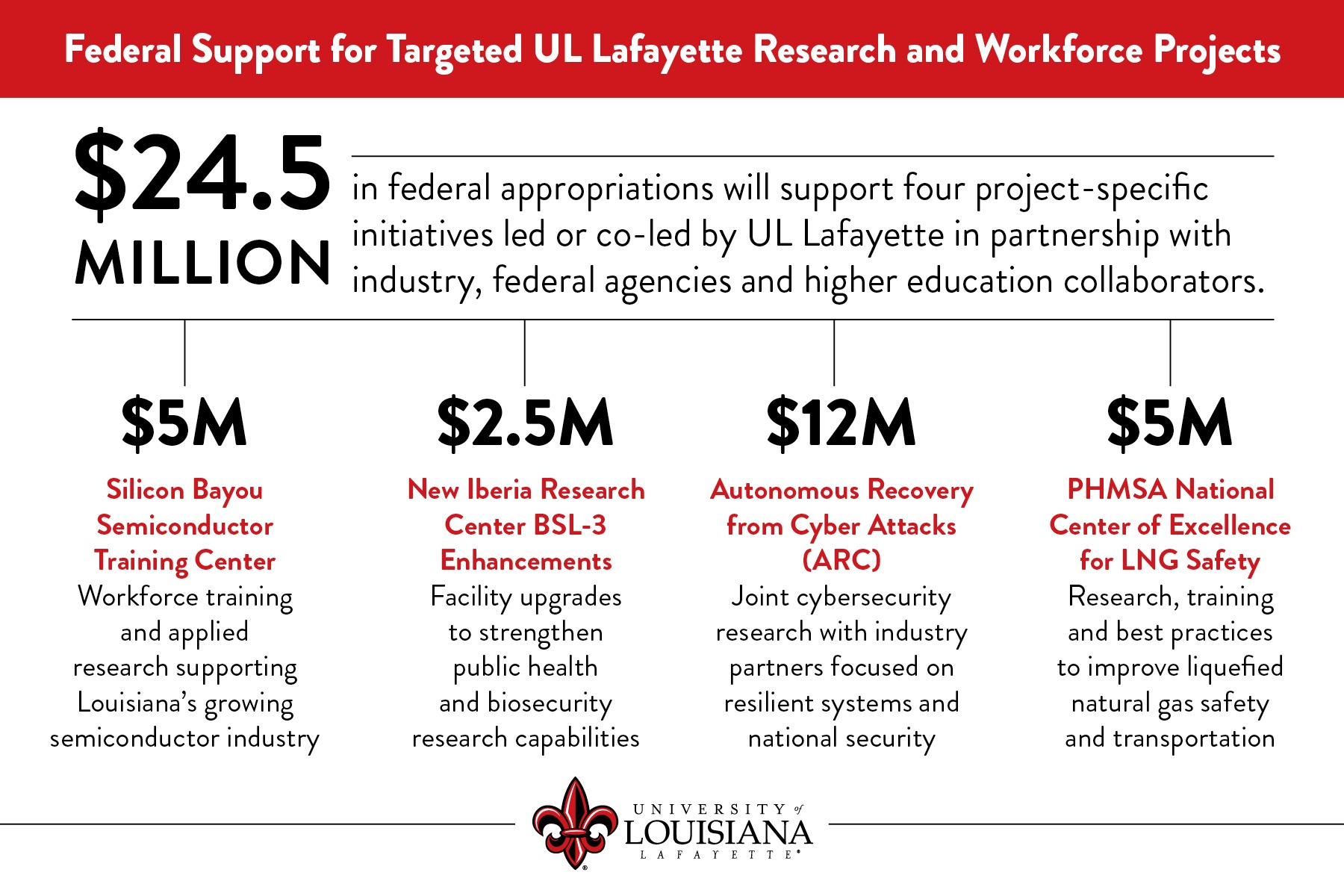
The University of Louisiana at Lafayette and its partners have secured nearly $25 million in federal support for four major initiatives focused on workforce development, advanced research, public safety and national security and defense.
The funding was included in FY26 federal appropriations approved by Congress and signed by the president. The appropriations support projects led or co-led by UL Lafayette alongside federal agencies, industry and higher education partners. Funding will be administered through these collaborative arrangements.
They include:
- $5 million for the Silicon Bayou Semiconductor Training Center to support the development of the next generation of chips.
- $2.5 million to enhance Bio-Safety Level 3 capabilities at the New Iberia Research Center to advance research and therapies against infectious diseases.
- $12 million for an Autonomous Recovery from Cyber Attacks (ARC) joint research initiative to advance national security and defense priorities.
- $5 million designated for the PHMSA National Center of Excellence for LNG Safety to support innovation and talent development for the industry.
Together, these appropriations strengthen Louisiana’s workforce pipeline, expand the University’s research capacity and reinforce its role as a partner to industry, government and communities across the state and region. The projects received support from Louisiana’s congressional delegation, including U.S. Rep. Clay Higgins and U.S. Sens. Bill Cassidy and John Kennedy.
“We are grateful to Louisiana’s congressional delegation for their leadership and advocacy on behalf of these transformative projects and, ultimately, on behalf of Louisiana’s future,” said UL Lafayette Interim President Dr. Ramesh Kolluru. “Their belief in our mission and support for applied research and workforce development enables us to expand targeted initiatives that strengthen Louisiana’s economy, advance national priorities and position the University for long-term impact.”
Project Details
Silicon Bayou Semiconductor Training Center — $5 million
Funding will support the establishment of a semiconductor manufacturing training and research facility on UL Lafayette’s campus, in partnership with South Louisiana Community College and other stakeholders. UL Lafayette has committed a 12,000-square-foot facility and invested $1.25 million to launch the center, designed to meet Louisiana’s workforce needs, support major industry investments such as First Solar and recruit the next generation of semiconductor manufacturing companies to Louisiana.
New Iberia Research Center Bio-Safety Level 3 Enhancement — $2.5 million
Funding will be used to expand and upgrade the BSL-3 facility to support research involving select agents that threaten U.S. public health. Enhancements include wastewater effluent decontamination, expanded security systems, upgraded access controls, organic waste disposal infrastructure and secure aerobiology delivery systems. The upgrades strengthen national biosecurity research capacity while ensuring compliance with federal safety standards.
Autonomous Recovery from Cyber Attacks (ARC) — $12 million
The ARC initiative is a joint research project with Radiance Technologies, focused on developing technologies that enable systems to autonomously recover from cyberattacks. Funding for the project will be shared between UL Lafayette and Radiance Technologies. The partnership reflects a broader strategy to expand UL Lafayette’s defense-related research portfolio and strengthen long-term federal partnerships supporting national security, resilience and advanced applied research.
PHMSA National Center of Excellence for LNG Safety — $5 million
The appropriation includes $4.2 million designated for the National Center of Excellence for LNG Safety and $800,000 intended to support the center’s Academic Research Consortium, co-led by UL Lafayette in partnership with McNeese State, Southern and Texas A&M universities. The initiative advances research, training and best practices related to liquefied natural gas (LNG) safety and transportation.