
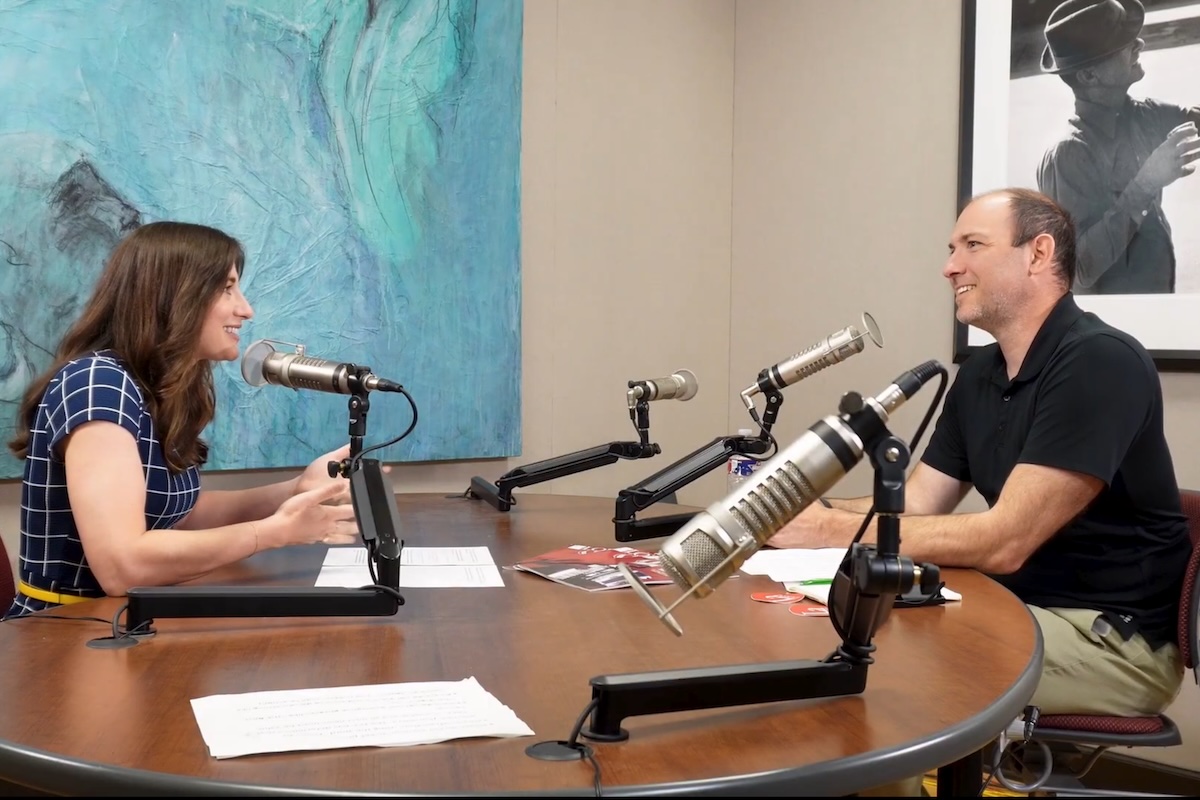
Jonathan Shirley, programs and operations director of the Louisiana Entrepreneurship & Economic Development Center (LEED Center) at the University of Louisiana at Lafayette, joined La Louisiane managing editor Marie Elizabeth Oliver to discuss the launch of the REDII Works FabLab — a new public makerspace at the LITE Center funded through a USDA grant focused on rural entrepreneurship.
The FabLab gives students, faculty, staff, and members of the Acadiana community access to 3D printers, laser cutters, a CNC machine, and design software to prototype ideas and build small-scale products. The LEED Center, which supports entrepreneurs and small businesses across the region, is using the space to expand its rural outreach through workshops and road shows in communities including Abbeville, Crowley, Opelousas, and New Iberia.
You can listen to the conversation with Shirley and La Louisiane managing editor Marie Elizabeth Oliver on KRVS, Spotify or Apple Podcasts. You can also watch on UL Lafayette’s YouTube channel or read an edited transcript below.
Marie Elizabeth Oliver
We're here today to talk about something super exciting. I know you just opened up a new space affiliated with the LEED Center, the REDII Works FabLab. So, tell us about it. What is this space?
Jonathan Shirley
So, it is really about helping people move from, "I have an idea" to "let's make something happen." Because in the entrepreneurship space, there's entrepreneurship and there's innovation. And a great way to think about it is innovation is finding all kinds of ways to pile up wood for the wintertime. Entrepreneurship is — you’ve got to light a match. At some point, you have piles of wood, but you can still freeze to death until someone has to come along and light a match. And this is more about the doing. We can get into a more about how each level really can be benefited by it, whether it's students who can work on ideas or entrepreneurs who need a prototype or something, and it all comes from a grant that we were fortunate enough to get from USDA to really focus on rural entrepreneurship. So, it's allowed us to create a space that's got, I think, 11 or 12, 3D printers and a laser cutter and CNC machine and all the design software to go along with that in one space that we have on campus, but also something we can bring to rural communities.
Marie Elizabeth Oliver
That's amazing. So, it's at the LITE Center. It's sort of makerspace-ish.
Jonathan Shirley
Jonathan Shirley, programs and operations director of the Louisiana Entrepreneurship & Economic Development Center (LEED Center) at the University of Louisiana at Lafayette, joined La Louisiane managing editor Marie Elizabeth Oliver to discuss the launch of the REDII Works FabLab — a new public makerspace at the LITE Center funded through a USDA grant focused on rural entrepreneurship. The FabLab gives students, faculty, staff, and members of the Acadiana community access to 3D printers, laser cutters, a CNC machine, and design software to prototype ideas and build small-scale products. The LEED Center, which supports entrepreneurs and small businesses across the region, is using the space to expand its rural outreach through workshops and road shows in communities including Abbeville, Crowley, Opelousas, and New Iberia.Very, very much makerspace-ish, a fabrication lab, and so “FabLab” is just more fun.
Marie Elizabeth Oliver
Yeah, I like it.
Marie Elizabeth Oliver
And so, talking a little bit more about the grant. It's on campus, obviously, but it's to support rural communities and entrepreneurship. So, how are you kind of going out there and reaching those communities?
Jonathan Shirley
Kind of two avenues that we can go that route, and so one is a road show, which we've done three of them so far, and have another six or so on the schedule throughout the summer and into the fall. And so, a road show is just for three hours, four hours, and we've been to Abbeville, we've been to Crowley, we've been to Opelousas so far. We’re still planning on Arnaudville and Ville Platte, and three or four more that we'll get over to, and so those are just sort of this, “let's go over and see what's possible.” We'll talk about entrepreneurship, we'll talk about online commerce marketing, we'll get into IP and how do you protect your ideas, and what are the levels of that, and then we'll bring some of our 3D printers just to really expose people to like what's possible. Because, really, we wanted to get people into the idea of either they have an idea or even if it's just sort of exposing them to the possibility of you can print in a rural community and sell online, and so you don't have to move. If you want to still live wherever you want to live, you don't have to go to the big city to open up a business. But you have to sell to people outside of your community, because what's hard about those smaller communities is, if we're just passing around the same $20, that doesn't do anything. And so, you have to get money from outside, and e-commerce allows you to do that. So that's one route, that road show route. And then our first workshop is going to be in New Iberia next week, June 2nd, 4th and 5th, so a Tuesday, Thursday, Friday evening, from 4:30 p.m. to 8:30 p.m. that's going to be in New Iberia at the Research Center, at the NIRC Research Center. And so that's three-day program. And so now we're actually build stuff, you know. So Day One, we'll talk about still more idea based. How do you figure out if you've got a good idea? How do you...you found something online, maybe that you think you could print and sell. Well, like, how does that work with licenses versus is anything open access? Is anything what if you start tweaking something, is it yours, is it someone else's? Nothing, it's not complicated, but it is stuff you should talk about.
Marie Elizabeth Oliver
You should know before you jump in.
Jonathan Shirley
You should know, and then how do you set up a Shopify site or something like that, and then so that's sort of Day One, then Day Two and Three is let's kind of go through a case study where we find something, build something, create something, print something, and if we were ready to go, we could go do that.
Marie Elizabeth Oliver
So very practical.
Jonathan Shirley
Much more hands on. We want to show you that you can kind of get things going.
Marie Elizabeth Oliver
Right, and 3D printers, they're not new necessarily, but it seems like in their current iteration they're much more accessible than they were when they first came out.
Jonathan Shirley
The accessibility is incredible. I mean, it's not nearly as expensive as it used to be. It's super easy to use. All of our printers are all from this Bamboo software, which Bamboo has an app, and I can print from my phone right now. I can send something to one of the printers in the LEED Center, and so that can be done from anywhere. It's a lot easier. You've got a huge library of things you can choose from. One of the favorite things that I printed recently is just a banana stand, and you can just hang your bananas, and if we know nothing else, there's always money in the banana stand. Because, as we think about getting to all people, anywhere rural or not, sometimes it's to commercialize an idea, and sometimes it's just you want to learn a new skill. We can't forget that's also a really good outcome. You pick up this new skill and maybe you take it and do something commercially, or maybe you just use it to improve your house, because now you can hang your bananas. Now they're not bruising. I mean, it's a thing.
Marie Elizabeth Oliver
The thing about a 3D printer is, you have an idea, you have something on a computer screen, or you have something you've jotted down, but it's actually a very tangible thing, even if it's a model. It's like you have something that you're holding that you can think about in a different way.
Jonathan Shirley
Absolutely, and so you can immediately look at it and go, “Yeah, this isn't going to work the way I'd originally envisioned it. I need to move this over a little bit. I don't know, I don't know why I thought it was that this size was right. It needs to be smaller. It doesn't need to be that big.” So, you can immediately get a real feel for that prototype, which is why you create a prototype, to really be able to see it, and with a 3D printer, prototyping becomes so much easier. You don't have to go and outsource it and pay $1,000 for some company to put something together for you. Now you can either do it at your house, you can come to us, and we can help you put something together, and then you have to decide, "OK, so now what do I do with it?" But at least you have more information than you had before.
Marie Elizabeth Oliver
Right, so you are marrying those two concepts of, you're helping people to create something, and you're helping them to market it and sell it, and all of that.
Jonathan Shirley
Yeah, so we take everything that we had already been doing on the entrepreneurship space, which is helping people with ideas or small businesses, or how do you run more efficiently and strategically, potentially, how do you grow? And we're just marrying that now with, "Hey, what if I'm creating something either totally new or I'm creating something physical that I haven't created yet. I've been thinking about it, but I don't, I don't know what to do with it next." I think that's where we had done the legwork and the foundational work of being a trusted entrepreneurship space, and now we're just adding on this idea of like, "Hey, now you can print something here."
Marie Elizabeth Oliver
Awesome. So, with anything on our University campus, we obviously have students involved, so I'm so curious how students are incorporated into this space and into the work that you do.
Jonathan Shirley
I think it's difficult to not be excited about all of it, but man, I'm really excited about the student element, partially because I'm fortunate to teach some entrepreneurship courses where we want students to create and sell and do stuff, and all my classes end up having to pop up at some point, so you're going to have to sell something. And the immediate feedback that we've gotten from pockets of students is that "Hey, these things exist on campus." It's not like we brought the first printer to campus, but a lot of the times they're all attached to classes and class projects. But they have less space to go and be totally creative, and so now this provides that avenue. It's one thing if you're over in Fletcher and you're creating physical stuff all the time, right, but if you're in journalism, if you're in the business college, there is no class project necessarily that is usually attached to create something physical. But if you are in mass communications, and you have thought about journals, and want to create this really cool Louisiana-based journal that's got a magnolia on it, you can now go to the laser printer and create it. To have a space on campus where that can happen is really special, and then you're also allowing opportunities for different disciplines to kind of interact with each other.
Jonathan Shirley
It's not the College of Businesses' space, it's not the College of the Arts' space, it's not the Sciences' space, it's anyone's space. So that by itself amplifies the opportunity for a business and an engineering student or an art student to kind of bump into each other, and that's where cool stuff happens, like that's where you're able to kind of, "Oh, I need this." I can't create a business student who, hey, they've created the product, and they maybe know a little bit about the marketing or the finances, but they know an app would be cool, but they have no idea where to start. Can bump into a computer science student who maybe has that knowledge, but has less knowledge on, I don't know, like, how do I decide what I should charge? And so now those students can interact in a different way in this space that's really for anyone.
Marie Elizabeth Oliver
And I know some of the students have had the chance to work with business owners and people with ideas, so they're kind of getting real-world experience in another way, too, right?
Jonathan Shirley
Right. Absolutely, and that experience is really powerful for them to get to talk to business owners who are already up and running, but it's still different than create it yourself, sell it yourself, it’s on you now, like that's just a different component.
Marie Elizabeth Oliver
It's a fun space. I mean, I've had the chance to go there, and it’s different from anywhere else on campus. I know it's available to anyone, but do you have certain times when you're welcoming students or welcoming the public?
Jonathan Shirley
For the summer, we're sticking to the traditional University schedule of 8 to 5, Monday through Friday. Even on Friday, we've got a situation where we can stay, you know, stay past 12:30. We can have students to come in, or faculty, or staff. That's another part of it. Please don't think that whenever we're talking about campus involvement, we’re only talking about students. This is a beautiful space of where I get to say, like, I don't care. Like if you have an idea, I want you to be here and do something with that idea. That's the most important and critical piece. A cup holder, a coaster, something that you think would help you, and you think, "Hey, maybe there's an audience for this, or I can go sell it at a farmers' market," like, let's figure out what that is. So that’s 8-5, Monday through Friday. The biggest thing they can just email us right now, the LeedCenter@louisiana.edu is the best way to reach out and schedule a time to visit. A time to visit is the best, easiest thing, because then we can show you what's there and get a chance to meet. We've got graduate students, a couple of graduate students for the summer, and then some student workers once the semester starts back up, who know what they're doing. Because this is where, like, I get excited, but I can show you how to push it from your phone to the printer, right outside of that, that's about the extent of my knowledge. But we've got people who can help. "Hey, I have this idea," and if you've already got it in a file, great. If you just have it a drawing, great. Like, there is no wrong. I was talking to somebody the other day, and they were like, "Well, is there a wrong way to get started?" Yeah, the only wrong way to get started is to not start. That's the only wrong way. Do nothing, that's the worst idea. Take it and just get us a place to get going.
Marie Elizabeth Oliver
So, really, anyone from the University community, anyone from the Acadiana community, this is a space that is available to anyone, and that's really very exciting. Before we go, is there anything else that you wanted to share, either about the work that you do with the LEED Center, or about this FabLab in general?
Jonathan Shirley
I just can't not mention this is that everything we are — the only way we operate at the LEED Center is this head and heart philosophy. And so I need people to understand that when you walk in or you call or you email, or however we get in touch, we start with the foundation that I care more about you than I care about your idea, and so I'm more attached to you. Like, how does this fit into what you want to do with your life? How does this push you along? And maybe it's a fun thing that you do, and that's all it does. Fine, maybe it's a, "I think this could turn into something great," and I will follow you however long you want to walk that path, because that's the most important thing. I mean, the head and heart sort of mindset comes from this idea that the greatest distance in the world is the distance between what you know in your head and believe in your heart. Like those 18 inches that exists in that space is everything. It's everything in the freshman classes that we teach, it's everything in the Honors Program that we do stuff with. It's everything that Scott and I do in the Music Entrepreneurship Program. It's everything with any accelerate program we do. It's figuring out how do we bridge that gap, how do we walk that space, and how do we help other people do the same thing. And so, this is just another avenue where we can do that, and I think it's important to realize that we attach to the person, not the idea. Because the idea might not be right, but if you feel comfortable coming in because you know that people care about you at this space, then you're immediately more likely to be wrong, like failure doesn't look the same. Failure looks different when you know that you're cared for and loved. Failure is just part of the process at that point. And we want to really get to that space, and so I realize that has nothing to do with the FabLab, but it's so critical.
Marie Elizabeth Oliver
It does, and in a way, the 3D printer is sort of a metaphor for this, because it's like you're printing things that you want to iterate off of, you're not trying to make the first thing absolutely perfect.
Jonathan Shirley
Because it's not going to be, like that's the point, it's not perfect, but it's a lot closer than it was when it was just in your head. Now we got it. OK, now we can manipulate it and mess with it and figure out something for it.
Marie Elizabeth Oliver
Yes, and I feel like people are really craving not only that sort of human interaction, that third space, but also tangible objects, because we're so screen-oriented, and I think we're seeing the pendulum go the other way.
Jonathan Shirley
Shift a little bit. Yeah, the only other thing I was thinking about was we're kicking around an idea to do more kind of maker competitions, and so I'll just throw it out there, and then I'll ask for forgiveness later. So, to kick off the semester, our plan is to take that first month of the semester and have students compete in designing dorm accessories. And so, I think that'd be really cool because that can be anything, right? I mean, it can be printed stuff that you can slide onto a table like this and hang your headphones. It could be, you know, I've seen plenty of, like, cell phone kind of holders that you can connect to beds and stuff like that, but, but truly, something that students could use right away, like, you're all moving in. It's a lot smaller than what you're used to, and so I'm really excited to see it. I know someone's going to come up with something crazy that would be like, "Oh, what a cool dorm accessory that I would have never thought of.”
Marie Elizabeth Oliver
Well, thank you so much for joining us, Jonathan. It's been fun, and I can't wait to see what comes out of the FabLab.
Jonathan Shirley
Yeah, me too.
Check back next month for more discussions with members of our University community. KRVS is listener supported public radio for Acadiana, a service of the University of Louisiana at Lafayette.
This story is part of La Louisiane, the official magazine of the University of Louisiana at Lafayette. Published since 1989, La Louisiane covers the University's research, students, faculty, alumni and Louisiana culture. La Louisiane is an award-winning publication recognized by the Council for the Advancement and Support of Education (CASE).
Photo caption: Jonathan Shirley, programs and operations manager at the LEED Center, discusses the launch of the REDII Works FabLab with La Louisiane managing editor Marie Elizabeth Oliver. Photo credit: Kade Parker / University of Louisiana at Lafayette
Audio production: Clint Domingue / KRVS
Video production: Kade Parker / University of Louisiana at Lafayette