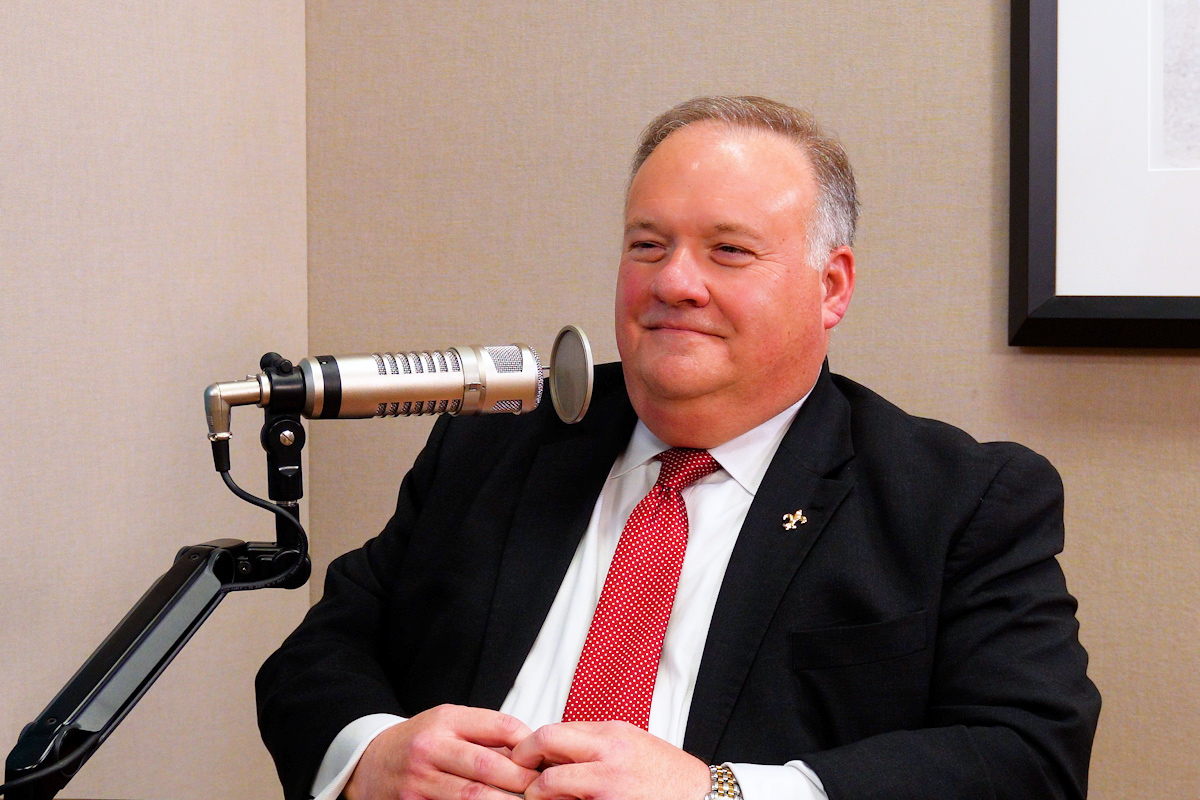
In her first interview as La Louisiane Podcast host, Marcelle Fontenot sits down with Dr. Andy Benoit to talk about student experience at the University of Louisiana at Lafayette. As UL Lafayette’s vice president for Student Success, Benoit’s focus is helping students at every stage of their academic journeys—from recruitment to graduation and into the workforce. Central to this mission is Louisiana Vision 2035, an initiative aimed at strengthening retention and graduation rates, expanding career readiness and bolstering the University’s academic and research missions.
Watch the conversation on YouTube by clicking here or read the edited transcript below.
Marcelle Fontenot
You're in a new role, but not new to the University. Take us on your journey from then to now, and what brought you back?
Dr. Andy Benoit
I was at the University from 2012–2016, and I had the opportunity to serve as director of admissions, and then a little bit later as the AVP in enrollment, and then left in 2016 to take my first of three vice president jobs prior to coming home. It took me to South Carolina, then to Texas, then to Illinois. Then Dr. Kolluru recruited me back to Louisiana, and I'm happy to be home here in a brand-new role that combines both enrollment management and student affairs. I'm very happy to be here and work with those areas.
Marcelle Fontenot
Let's talk about student success. Your division is responsible for a wide variety of factors from admission to graduation. How are you and your staff redefining what a student's successful journey looks like?
Dr. Andy Benoit
Well, certainly we're looking at it in terms of a continuum when a student is initially recruited to the University, all the way through matriculation, and then the continuation and persistence all the way toward graduation. So, all the inflection and intervention points that are associated with that, the times that they're recruiting, getting financial aid, or getting benefits if they're military, or if they are needing to register for courses, get advising, and then all the things that help them along the way, and then the enriching student experience that helps them to find belonging and participation and involvement here at the University.
Marcelle Fontenot
Recruitment is one factor; let's talk about retention as well. That's been a lot of focus here at UL under Dr. Kolluru's administration. It's one thing to get the students in the door; it's another thing to keep them here.
Dr. Andy Benoit
Right, and so we take no pride when a student doesn't continue. You know, I used to say years ago that we were an admissions office and not a denial office. Well, as an institution, we have only two acceptable outcomes. First, when a student comes to the University, they graduate within four, hopefully four years, but no more than five. When they come to the University, they graduate and begin the career that we've trained them for, or they go to the graduate or professional school of their choice. All the inflection/intervention points that we do along the way are to help them persist, to help them continue, because right now, between the first and second year, 73 or 74% of the students at the University of Louisiana at Lafayette return for the second year. If you put four students lined up in a row, three of them will come back; the other will not, and so that's not acceptable for us. We want at least 90% of our students to be able to come back from year one to year two. And then graduation-wise, you know, we're looking at students that graduate from the University. About 26% of them graduate within four years, and only about 52% of them graduate within six years. In terms of that, if you look at four of your friends when you're here as a student, two of you will not get a degree within six years at the University of Louisiana at Lafayette. Two will not come back. They will have accumulated debt, but they will not receive a diploma, and that's also not acceptable for us. What we're trying to do in our Vision 2035 is to be able to bring those numbers into better alignment with research, which with R1 universities throughout the country, we want our rate to be approximately 75% for students graduating within the four years, and we want that number to be about 70 or 75% and we want that number to be about 85%.
Marcelle Fontenot
Let's talk about enrollment just for a minute. We recently released numbers about the University's enrollment this year compared to last, and there's a decrease of about 400 students. That's not only UL, that's also a trend nationally. But what about potential students, those graduating from high school, and even those who are already in the workforce who are considering maybe I should go to college? What do they need to know about the benefits of a degree from UL Lafayette?
Dr. Andy Benoit
One of the things that UL has always been strong with is our community here. When our students come, you will find belonging here. You will find faculty who are dedicated to imparting knowledge, who will help you be excellent in your field. That will help you to be able to, in some cases, change generational trajectories in your family or in your own lives. We try to do that from the get-go. And one of the things that we are doing in actively recruiting our students, we are reengaging a lot here in Acadiana, but we're also reengaging throughout Louisiana, in our bordering states, in areas even in California, in Florida, the Carolinas. We're looking at bringing our message back to places that we had established markets in years past. We want and know that every student has potential, and we want them to know that UL Lafayette is interested in them. One of the things that we take pride in is being able to go and visit with students and helping them figure out what their place is here. We will be in a lot more schools and high schools. We'll be in a lot more community colleges. We will be present. That is number one. Number two, we will spend a lot more time talking with students and their families because we want to be honest about the cost of higher education because there is a value proposition. Parents have and students have an opportunity to choose: do I start off at the four-year institution and make my commitment and get going on my career, having all the preparatory things happening while we're there, or do I initially start at a community college? Well, there are opportunities for a variety of people, and our job is to help match up people and to be able to find out what their best fit is. We will be helping not only to bring in students here to the University, but if students aren't prepared to be successful here at UL, we've built relationships with our local community colleges to be able to defer their admission, to be able to have them start out there and then continue their mission here after they've been there for at least a semester or a year. There'll be plenty of opportunities for us to showcase. But we have so many more first-generation students now than we ever have been before. We have so many lower income and hardworking families who are viewing this as an investment in a lot of ways. We are looking for the opportunity to be able to share what it takes to be able to come to college and also to be able to be successful. And I always give the story: I was a first-generation college student from Southwest Louisiana, grew up on a rice and cattle farm. My mom had a high school education. Dad had a middle school education. I should have been a statistic. At that point in growing up, people invested that time and effort in me and helped me to understand what it took to be successful. A lot of times, you know, we got Pell grants, or we got whatever we had, and that paid the majority of our tuition. We have some families out there right now that think we'll just get a grant; it's going to pay for everything. Not necessarily, not anymore. We have to talk about things like grants and loans, work-study, all these things, scholarships that help students to be able to fund their education and help sustain them while they're here. We're trying to be purposeful in all those actions.
Marcelle Fontenot
Let's talk about that. Let's hone in on that for just a minute. I have my oldest son as a freshman in high school, and to hear all the ins and outs necessary for going to college, if that is what a student and/or their family is looking for. When should you start, and what basic questions should I, as a parent, be asking, or my student to their guidance counselor?
Dr. Andy Benoit
It's never too early to start, so progressively. We are trying to now outreach to students when they are freshmen in high school, if not before, to give them some sort of connection to the University, especially to students who aren't familiar with college or their families aren't familiar with college. To give them an opportunity to get to know the University even more. By the time you get to be a junior in high school, you have to have a pretty good idea of what your top five schools are. You have to have a pretty good idea of the financial situation and what you're going to be looking at. Because by the time you get to be a senior in high school, you really need to have it nailed down to your top three. You can make a decision, you can look at costs, you can look at your scholarships, all those things. But when I say we're going to be a lot more purposeful with parents and students, it’s having those discussions early, because some families say, “I can get this if I had enough time to be able to plan.” What we're trying to do as a university is to help them along the way with that, help them to plan early. But that also involves us outreaching a lot earlier, sending direct mail, going to sometimes middle schools or elementary schools, having more of a purpose and connecting what we try to do in order to be able to help communicate the message. But the other part of that is the University has so many resources that we partner with so many school districts and high schools and middle schools, and having a lot of information out there, we do financial aid nights. We have different college fairs. We have private visits where our recruiters will go there and answer questions or be accessible. But everything we do out there is to get those students onto our campus, the students and the families. No matter if they are a freshman, we start having immersive experiences here when they're sophomores in high school. We have a sophomore Saturday. We have a junior day. We have a variety of open houses for seniors, and a variety of things that are happening on campus. Everything we do in the outreach, we do in the schools or the communities is to bring them on campus to talk with us here, find out the resources, visit with our faculty, get to know the University even more. Because a lot of times students will be outside of our area who need to get to know what we have to offer. But right now, approximately 50% of our incoming freshmen are all from Acadiana. Outside of that, our largest markets are Baton Rouge, New Orleans, and then the other areas in Louisiana. But we have a lot of our students who are local, and approximately 90% of our students currently are from the state of Louisiana. Now we want to diversify that a lot more, but we do serve our population here in Acadiana greatly.
Marcelle Fontenot
We know we're talking about the process of coming to UL, and it's never too early to start enrollment to graduation, student success. Let's extend that journey even more from employment to overall success in life. What do you need from not only alumni but business owners, community leaders in helping our students who are here become successful even after they turn the tassel?
Dr. Andy Benoit
Once they turn the tassel, our goal is that by the time a student gets to be a senior, before they graduate, they have two job offers, so that they can really consider what they want to do and pick what's best for them. We have to have a lot of partnerships with our community, with our businesses, and with our alumni that allow us to be able to engage in those experiences with our students. One of the things that we're doing with Vision 2035 is to be more purposeful in career and professional development, and give students immersive experiences in their majors that give them opportunities for experiential learning, that give them opportunities for internships, co-op programs that will give them hands-on experience, that will give them a greater opportunity to have more job offers and to be able to start their careers a lot earlier. You know, we have those things that have been built out over time in areas like engineering, education, or business, and our goal is to do that across the board in every area. An example would be, we've got part-time job career fairs that we do have for our students, but our largest annual career fair is next week. Actually, we have more than 170 different employers that are going to be at the Cajundome, and they will be there to be able to help our students find internships, find co-op programs, find jobs for a lot of them that are about to graduate, and make those connections with employers throughout Acadiana, across Louisiana, and even in Texas or other areas. The United States Department of State is going to be hiring here, hiring people. There's going to be a variety of agencies that will be there to be able to work with our students, and we have about 717 different corporate sponsors that are going to be providing that event for us. And this is actually the largest one we've ever had. And so, giving an opportunity for our students to be able to showcase what they have for these people gives them greater opportunity for success. But looking at what we're trying to do, we're trying to prepare those students to be able to go and get those jobs a lot earlier with immersive experiences. We're also utilizing technology to be able to help them prepare. We just signed on to a software program, an AI program that allows them to be able to practice interviewing, that allows them to be able to bone up on their résumé, to be able to look at job skills, soft skills that they need to build, utilizing the latest technology that is at their fingertips. They don't necessarily have to do what we all had to do in the olden days and go to career services and have someone help us. The AI intervention can help them to do that. We just intervened with that prior to the beginning of the fall semester, so we're trying to employ a lot of different tactics to be able to prepare our students to be successful.
Marcelle Fontenot
Are you finding that students lack soft skills? I know we're of a different generation, and communicating is entirely different than when you and I were in this process and seeking out a new way for them to get those kinds of skills. Are you seeing that students need that? That's just the little extra that they need to take it to the next step.
Dr. Andy Benoit
You know, when we were in school, you picked up the phone, you talked to people, and everything was more personal. In the interventions that we've had with email or with social media and all those things, things became a little less personal. And especially after COVID, we had a lot of folks that lost periods of time and socialization that affected the way that they approach things. What we're trying to do is to have a delicate balance, right? That gives them an opportunity to utilize the latest technology that they want on demand at their fingertips. But also at the very same time, making sure they don't lose human interaction. Because we've had employers tell us time after time that what they are looking for are graduates that have those soft skills: the ability to communicate, the ability to be able to be part of a team and work with other people. We're trying to make sure that our students have those NACE capacities that allow them to be able to compete in today's market. But also prepare them to be leaders in the industries that they have, not only in areas that are the communication industries or any of those things that are necessary, but in areas like engineering or other areas where we want to make sure that our graduates can stack up to anyone, no matter where they are.
Marcelle Fontenot
And if I'm listening, and I am a business owner affiliated with a business or a program, and I want to get involved and help one student, one student is a start. Who should I contact?
Dr. Andy Benoit
There are a variety of ways. First, if you're looking at helping students with careers or anything like that, our career services office is a great place to start. We've had a lot of our businesses reach out that want to be part of the career fair or want to be able to sponsor programs within career services to be able to showcase. For example, we had a firm out of Baton Rouge come in that is working with them to sponsor activities for specific engineering majors that they want to be able to hire at their firm. We've had a lot of businesses partner with our career services. I'd say there, but also, we're always looking for mentors, right? We're looking for mentors for our students that will work through career services, that will work through our alumni association, that will have opportunities to engage with our students. Obviously, we want to do that and give our students the ability to be able to work with them, get to know them. But also, at the very same time, we want to be able to have our community get back involved with the University.
Marcelle Fontenot
Mentoring makes such a difference. You have worked not only here but in other places across this country. Tell me a quick story that you hold with you—that is your definition of what student success looks like.
Dr. Andy Benoit
With my background, I always have an affinity for why I wake up every day, why I go into the office, and why I'm committed to helping students be successful. Because people did that for me, I never lose sight of that. I want to take it back to right when I started as a recruiter at McNeese. I remember the first student I recruited. Lord, I spent more time with that student than anyone else I've ever recruited, right. And I still remember his name. I remember his major. I remember where he was from, everything associated with him, and I remember after four years, that student graduated, and I was there at his graduation and everything there. You build relationships in everything that we do in higher ed, and that's the beauty of it. And that's always been the beauty about UL, why we do what we do. And when Dr. Kolluru recruited me, he says, “Look, we got a big mission here. I need to have you come back home.” I was in Illinois. We were doing great things. I came back to UL. Yes, the job is great. I love my job. I love working with the people I work with. But I came back to UL for the people, and I came back for the people because every day our faculty, our staff change lives, and it's everything we do. From helping a student find their way when they're coming in, transitioning into the University, helping them find their classes, helping them understand—well, you're not doing so hot, let me help you out here—or helping them find a place to eat, or helping them when they're at their lowest point. All those things have been what has made UL special over the years, and for me, that's the defining thing. That's why we exist in higher education, so that we can change families, we can change students, help them to achieve what they want, and change the world. And that's what we do every day.
Marcelle Fontenot
That is absolutely what we do every day. You started March 1, I started April 1, and one of the things I noticed too, you mentioned community. This is such a wonderful community, both the campus community and the community that surrounds us here in this area. I mean, we've said it before: we move different, which is what makes UL this wonderful and special place, Dr. Benoit. Thank you for being here with us.
Check back next month for more discussions with members of our University community. KRVS is listener supported public radio for Acadiana, a service of the University of Louisiana at Lafayette.
This story is part of La Louisiane, the official magazine of the University of Louisiana at Lafayette. Published since 1989, La Louisiane covers the University's research, students, faculty, alumni and Louisiana culture. La Louisiane is an award-winning publication recognized by the Council for the Advancement and Support of Education (CASE).
Audio production: Clint Domingue / KRVS
Video production: Kade Parker / University of Louisiana at Lafayette
La Louisiane podcast: Building a path to student success with Dr. Andy Benoit
Published