
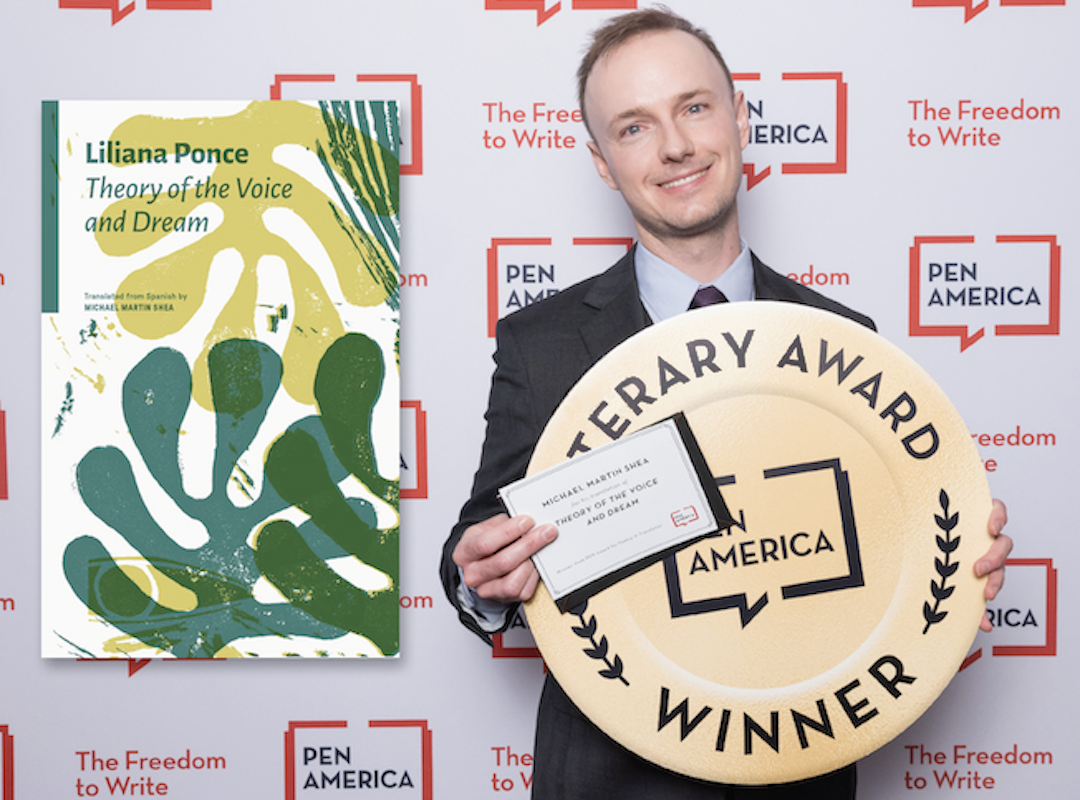
Dr. Michael Martin Shea, an assistant professor of English for the University of Louisiana at Lafayette’s College of Liberal Arts, is the winner of a 2026 PEN America Literary Award for his translation of Argentine poet Liliana Ponce’s Theory of the Voice and Dream.
PEN awards are among the most prestigious literary awards in the United States. Along with works of translation, the awards recognize fiction, poetry, science writing, essay, sports writing, biography, children’s literature and drama.
For Shea, 37, his PEN Award for Poetry in Translation bookends a 10-year project he began in 2015 while studying and teaching as a Fulbright Fellow to Argentina. Shea accepted the PEN award during a recent ceremony in New York City. “It was surreal to hear my name called because I didn’t expect to win in my wildest dreams. But it’s validation for all those years I spent working on this, and that they were put to what someone else thinks is good use. And hopefully it opens up wider readership for the book, for Liliana's work,” Shea said.
Those odds are good. Although Ponce is one of the most notable poets in Argentina, Shea’s effort represents the first time her poetry has been translated from Spanish to English. He rendered, according to the writers, editors, critics and translators who judged the PEN Award for Poetry in Translation entries, a masterful interpretation.
A line from the citation that accompanied the honor reads: “Shea’s translation deftly captures the essence of Ponce’s serial poems on creation and absence, offering them with an apt, skillful contradiction that melds appropriate ambiguity and admirable precision.”
Shea happened upon Ponce’s work by chance. After arriving in Argentina, her publisher, who Shea met at the introduction of a friend, gave him dozens of books. Among them was Fudekara, the fourth of five books of Ponce’s poetry that have been published in Argentina. “For whatever reason, it was one of the early ones I picked up and I thought it was beautiful. That was my introduction to her work and it all kind of rolled out from there,” he said.
Soon, Shea dug into the formidable task of rendering Ponce’s work in English despite no formal training in literary translation. So, his comprehension of Ponce’s work developed incrementally, taking shape with draft after draft.
Many of those drafts were composed while he completed his PhD in Comparative Literature and Literary Theory at the University of Pennsylvania. The curriculum included courses in translation theory, which augmented the applied learning he received while translating Theory of the Voice and Dream.
“I didn't know the various strategies or approaches to translation when I started; it was only kind of as the project was going on and as I was sort of getting inducted along the way that I was able to refine my methodology,” Shea explained.
Translation is often rightly considered as complicated and daunting a pursuit as any in literature, an endeavor that extends far beyond swapping words in one language for the most fitting words in another. Beyond meaning, a translator must weigh thousands of variables and make choices reliant on interpretation and concessions, since no two languages fit together perfectly like opposite sides of a mold.
Spanish, for example – a romance language that Shea began learning as a middle schooler in Clearwater, Florida – is characterized by open vowel sounds and features a flowing, melodic cadence. English, on the other hand, is more consonant-heavy, with many words that end in hard stops.
“Spanish has this sort of musical quality, and that presents situations where you have to decide, ‘Okay, do I go with what I think is the most literal translation of this word or do I go with the one that kind of has a musical quality but is a little more airy or abstract?’” Shea reasoned.
“Or how do I manage some of the formal qualities – a line break that doesn't really conserve the flow of the sentence? Or the ways subject verb ordering is different in Spanish, and when does that matter and when doesn't it?” he added. “Those are the sorts of things I wrestled with over 10 years. And ultimately, I kind of just concluded that translation is really an interpretive act.”
It all amounts to experience and expertise that Shea brings to his students and to his scholarship. Shea’s teaching and research interests include poetry and poetics, hemispheric American literature, 20th century literature, critical theory, translation studies and comparative literary studies.
He is also accomplished poet in his own right. Shea is the author of the forthcoming poetry collection The Immanent Fields, as well as several chapbooks, including, most recently, To Hell With Good Intentions and I’m Sorry But None of This Is My Fault.
“Everything feeds into each other. The translation feeds the teaching, which feeds the research, which feeds the creative work. It's all part of, for me, a general investigation of what it means to sort of live with and write in language, and to write across languages,” Shea said.
Photo caption: Dr. Michael Martin Shea, an assistant professor of English at the University of Lafayette, is the winner of a 2026 PEN America Literary Award for his translation of Argentine poet Liliana Ponce’s Theory of the Voice and Dream. Photo credit: Pen America