
Earlier this year, the University shared the news of a research project that used campus live oak trees to better understand Earth's changing atmosphere. In this episode of La Louisiane podcast, the researchers behind that work discuss how the project began, what surprised them most and why the findings matter. Listen to the conversation on KRVS, Spotify or Apple Podcasts. You can also watch or read the full transcript below.
[Read more: Student researchers use campus oaks to track rising carbon dioxide levels]
Watch the conversation with Dr. Brian Schubert, professor in the School of Geosciences, and recent chemistry graduate Izzy Lara on UL Lafayette’s YouTube channel or read an edited transcript below.
Marie Elizabeth Oliver
Welcome to La Louisiane, conversations brought to you by the official magazine of the University of Louisiana at Lafayette. Today, we're welcoming Dr. Brian Schubert from the School of Geosciences and Izzy Lara, a recent graduate in chemistry. Thanks so much for joining us.
Brian Schubert
Thanks for having us.
Izzy Lara
Yeah, of course.
Marie Elizabeth Oliver
So, we're here to talk about a research study you were both involved in, one that started right here on our own campus with live oak trees, and I know for so many of us they're very iconic to this campus. So, I heard you know that these results were very surprising to you. So, I'd love for you to just kind of start from the beginning, explaining how it started, and then what you actually found in the process.
Brian Schubert
Very good. Yeah, so you know, our trees have been living on campus for more than 100 years. Some of them, they're a part of our community, and our campus have a rich history to tell us. And so we set out to actually see what the stress level of our trees are. Are they healthy? Are they doing well? And one of the tools we can use for that are stable carbon isotopes. And as a geologist, these are really useful chemical analyzes that we can do that can tell us a lot about the past environments. So we set out to do that, and what we got was something else from what we set out, and that's often why we do research. We don't know what we're gonna see.
Marie Elizabeth Oliver
That's the fun part. So, Izzy, what did you find?
Izzy Lara
So, when it came to our findings, we had found numbers that had been never recorded before. They were a lot lower than what we had seen in published data in that certain genus of the tree that we were looking at, and it was just surprising to see you go to your classes, and you go to these labs, and you know what kind of results you're going to get at the end of those four hour grueling labs, but after doing and working on this project for about two years, even now it still surprises me, the results that we've gotten.
Marie Elizabeth Oliver
Wow, wow. So, for people who don't understand, who have never been in a lab, what is this analysis like? What, what are you actually doing in the lab?
Brian Schubert
Yeah, so there's two stable isotopes of carbon, and so carbon is carbon because it has six protons in the nucleus, that's what defines the element, but there can be a different number of neutrons, and that changes the mass, changes the weight of that atom. And we have an isotope ratio mass spectrometer in the School of Geosciences. It's a really, really, really precise scale, essentially, that can tell the differences in masses of these two isotopes. And what's great about these two isotopes is they can be traced through the environment from fossil fuels to volcanic emissions of CO2 they all have unique chemical fingerprint that goes into the atmosphere and then through photosynthesis that carbon is transferred into the into the plant.
Marie Elizabeth Oliver
OK, and so you're actually taking the leaves from trees on campus. You did you pick any certain trees or were you kind of taking a sampling?
Izzy Lara
We tried to do a good breadth of campus. We mainly focused around areas like Hamilton Hall. We tried to get some around the union, the swamp. We even tried to focus on areas where construction was heavier on campus to see if the construction was affecting the carbon isotope levels of the trees. Luckily, we didn't find anything significant where the construction could have been harming the trees, which is good to know. Yes, but with that, it was just exciting, and getting just a good breadth of what was on campus was important.
Marie Elizabeth Oliver
So, these levels that were kind of — that really stood out. What is the significance of that, like just in the general research, you know, overall.
Brian Schubert
Yeah, it just shows how quickly our atmospheric chemistry is changing. So, as a geologist, we use these measurements all the time. We use them primarily to look at how carbon dioxide levels in the past have changed. They're recorded within the fossil plant materials, in coals, in marine phytoplankton that become our oils, these fossil fuels that we use, and they can also record something about the water status of the plant. There are these pores on the leaves called stomata that open or close depending on how water stressed the plant is, and that also affects how much carbon is going into the into the plant. And so these values that we got were, you know, we've studied fossil plants through, you know, the history of photosynthesis, going about hundreds of millions of years, and at least for the last 66 million years, since the dinosaurs went extinct, we haven't seen values this low, and so the reason for that is that the source of CO2 going into the atmosphere is from combustion of fossil fuels of dead plants, and they have a low carbon isotope value to start with compared to volcanoes. And so our natural background atmosphere is volcanically derived carbon, and we're mixing into it this plant source to. Five carbon, and they have a very different isotopic composition. And so all of these leaves that we've been, been have been measured in the past, and this is one of those common measurements that people make in stable isotope geochemistry. It's been since, I think, the 1950s before measuring leaves. All of these leaves have been measured under a different atmospheric chemistry than we have today, CO2 levels were lower, and the carbon isotope value of the atmosphere was higher. Both of those things have been changing really dramatically, and I think what surprised us most was just how quickly and dramatically. I mean, we've been seeing values in the literature, we learn about these things, we study them in our classes, and but the data's from last decade or the decade before, and in that time it's changed substantially. And next year and next decade is going to be even that much more different. Wow, it's it's it's just really unusual geologically.
Marie Elizabeth Oliver
Yes. OK, well, that's super interesting. And so what I mean, besides just the fact that you're seeing these different levels, does that have any impact on the trees themselves or other, you know, organisms?
Brian Schubert
Yeah, so it can affect the water use efficiency of the plant. So, rising CO2 levels generally changes the water use efficiency. They become more water use sufficient. That's a positive thing. You hear about situations where you get a greening of the planet from elevated CO2, it's food for the plant. Yes, but the problem is that you also need enough water for the plant to take advantage of that. We also need enough nutrients. And so if you have enough fertilizer, enough water, you can grow bigger crops. We see this happening. It's often a reason people say rising CO2 is good. Okay, there's a lot of negatives that go into that as well.
Marie Elizabeth Oliver
I see. So, those of us with big live oaks in our yard, maybe, maybe they might need more fertilizer than they did?
Brian Schubert
To take advantage of it. And typically, in your yard, you have enough resources to mulch it, it's well taken care of, but yeah, trees today above ground get about 33% bigger than they did 100 years ago, just through this fertilization effect of more CO2, and the roots get bigger as well below ground.
Marie Elizabeth Oliver
OK, interesting. Well, if you're just joining us, this is La Louisiane, and I'm managing editor Marie Elizabeth Oliver. I'm here with Dr. Brian Schubert from the School of Geosciences, and Izzy Laura, a recent graduate in chemistry. So, Izzy, I know you conducted this research alongside your fellow classmate Clinton Vincent. How did the two of you work together, and how did this experience shape your time at the University?
Izzy Lara
So, I knew C.J. whenever we were in high school, so it was comfortable knowing that it was a familiar face in the lab. All this lab experience was something new to me, so I was excited to go into it with a familiar face. When it came to in the lab, though, we kind of put on our headphones, we did our thing. Sometimes we would pause the music and like chit chat for a couple minutes and kind of recap on how our day was going. So, we were able to become pretty close during these two years, and he's definitely going to be someone that I keep in contact with whenever I go away.
Marie Elizabeth Oliver
Amazing. And so, how, how did this experience kind of shape what you decided to do next? I know you have big plans going into the fall.
Izzy Lara
Yeah, so research being introduced, it's something that, while you may be working on the same experiment for multiple days at a time, there are so many questions that could just pop into your head at any point, and it's just a never-ending mystery. I like to think of research as like a big crime scene. All the data that you're looking at, it's kind of putting all the evidence together to get the results, and sometimes crime scenes go unsolved, and sometimes research goes unresolved as well. So it's kind of like that, and whenever it does become resolved, and whether you get the results that you want or you didn't, it feels like you get that sense of accomplishment at the end to know that no matter what you're doing, it's something that could potentially change the way that people look at things.
Marie Elizabeth Oliver
Wow, so and you're going to continue your studies?
Izzy Lara
Yeah, so I'll be continuing at the University of Connecticut this fall, getting my PhD in chemistry.
Marie Elizabeth Oliver
Amazing, amazing. And I know this research was supported in part by the Vernon and Ruby Langlinais Endowed and Non-Endowed Research Funds in Sciences. What role did this support play in making the work possible?
Brian Schubert
This is really the only reason this work was possible, and so this was donation to the College of Sciences. We wrote a proposal to do this work, and it got funded through this. It's to support undergraduate research, and so it paid for all the lab analyzes, it paid for to get a stipend, a pay for doing the research, and it paid to present the work at a couple of conferences as well to help disseminate these results, and you know, since the results were so exciting, Izamary was able to go to out of state to regional and national conferences to present this work,
Marie Elizabeth Oliver
And what kind of feedback have you gotten from people so far?
Izzy Lara
Whenever I would go to conferences, I would get questions as simple as, "is what you're doing hurting these trees, plucking the leaves off them?" Fortunately, it does not, or things like, "is there any other determining factors that could be affecting these trees, other than the CO2 levels?" And that kind of helped us gear towards in southern Louisiana, we have a lot more of a heavier rainfall than in other data sets that we were seeing around the world, like in China or in South America, with a lot more drier climate, so that helped us believe that with the more rain that we're getting, it also helped influence those isotope levels.
Marie Elizabeth Oliver
OK, wow. And I know you've, Dr. Schubert, you've studied, you know, plants and plant fossils from all over the world. What makes our sort of the plants here in South Louisiana, in Acadiana, unique? Would you say?
Brian Schubert
They're unique, I guess, in space and time, but one of the interesting things from a geologic perspective is how much our climate can change, and this gives us really good perspective on future climate change. We can essentially go back as a time machine to fossil plants and look at what does the world look like when CO2 levels are this high or when the carbon chemistry is this different than today, and that then can be used to test our models of future climate change, and so we have — one of the sites we visit is in Northern Canada, where there's a fossil forest up near the North Pole, up in the Arctic Circle. It has cypress trees, it has on redwoods, it has a vast forest. There's alligator fossils from up there, there's turtle fossils. It looks a lot like Cypress Lake on campus.
Marie Elizabeth Oliver
Yeah, I was going to say it sounds familiar.
Brian Schubert
It does, and so the climate can be quite different. At that time, you know, where we are right now would have been underwater. There was no ice on our planet, no ice sheets, everything was melting. Sea levels are much higher, and so, as geologists, we use that for exploration purposes, for interpreting past environments. There's a lot that goes into this, and the data set that we collected on this project will help us calibrate those models when we apply it to these fossil specimens.
Marie Elizabeth Oliver
I see that was going to be my next question, kind of where you're going next with the research. So, I think you answered it, but anything else?
Brian Schubert
Yeah, so today we have a pretty narrow range of climates to compare to, you know, our historical records of CO2 in the atmosphere, go back to the 1950s we can go back further using ice core records, but beyond that, you have to use some other geochemical proxy to understand this, and so today our CO2 levels are up to about 430 parts per million, gone up about 100 ppm in the last 50 years, which is 25-30% increase, which is a lot, and so these values we've never seen them. We've seen them in the geologic past, we've never seen them in recent human history. So, this kind of extends our calibration curve that we can then apply to these fossil record sites.
Marie Elizabeth Oliver
Neat. And Izzy, what are you going to kind of take with you from what you've learned from this research into your graduate studies?
Izzy Lara
I'm definitely going to take in to never stop asking questions. It's always said that no question is a dumb question, and that's really doing undergraduate research has really solidified that for me, and to always be willing to give someone a chance. I approached Dr. Schubert as a sophomore here, and a lot of people don't get involved in research until their later years in undergraduate, and luckily he took a chance on me, and now we were able to come up with these amazing results that we've been able to share with so many people now.
Marie Elizabeth Oliver
Yeah, exciting, you hit it out of the park on your first pitch. Well, anything else before we go about either about the research study or just kind of about supporting research in the College of Sciences?
Brian Schubert
Yeah, so at least in the School of Geosciences, and this probably goes for the college as well, there's a big emphasis on undergraduate research, and so we have a lot of field-based learning experiences, we're developing internships into our curriculum, a lot of hands-on learning towards careers, and so, of the nice things of being a geology major or an environmental science major is, at the end, you can become a geologist or an environmental scientist, and there's a lot of careers for that in South Louisiana, and I think that a lot of students don't get exposed to this until they're at the University. We don't have an earth science as part of the high school curriculum in Louisiana, and so a lot of our majors don't know about it until they're here. They'll take an intro class with us, they get really excited about it, they get engaged in the research, and then they're hooked. And so I think that's probably kind of the one main thing going for us.
Marie Elizabeth Oliver
Yeah well, that's a good point, because I know, especially right now, people are so tuned into, well, the job market's changing, and things that felt like a sure bet, or maybe not a sure bet. So that's a great point, that, like, this is something, if you know you want to stay here, even if you want to go off, it's something that is in demand.
Brian Schubert
We have a lot of jobs in geology and environmental science here in South Louisiana, it's Sportsman's Paradise. There's a lot of people are quite engaged with our coastal area, which is where the geosciences falls, but it also allows you to travel. I didn't get to go around the world unless I was a geologist, it wasn't something I did until going into this career field.
Marie Elizabeth Oliver
Amazing. Well, thank you both for joining us, and I think I'm going to kind of look at the trees around campus a little differently now.
Check back next month for more discussions with members of our University community. KRVS is listener supported public radio for Acadiana, a service of the University of Louisiana at Lafayette.
This story is part of La Louisiane, the official magazine of the University of Louisiana at Lafayette. Published since 1989, La Louisiane covers the University's research, students, faculty, alumni and Louisiana culture. La Louisiane is an award-winning publication recognized by the Council for the Advancement and Support of Education (CASE).
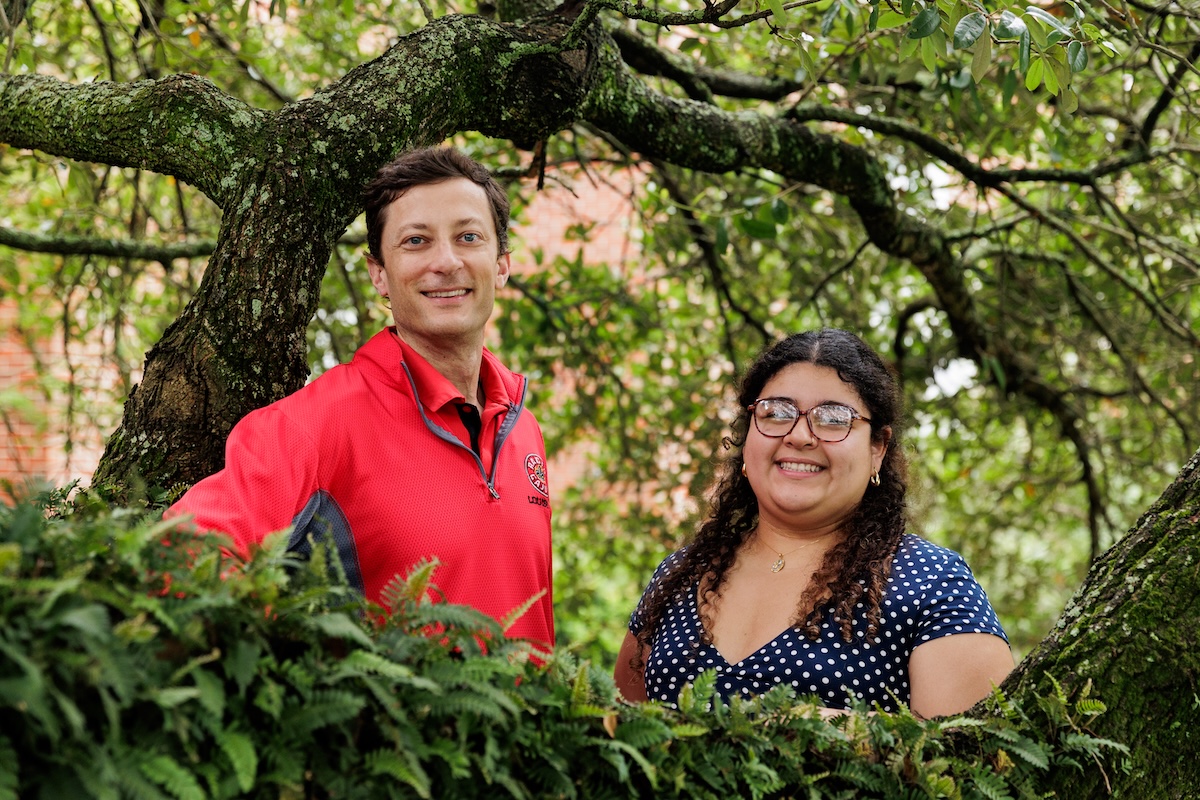
Photo caption: Dr. Brian Schubert, professor in the School of Geosciences, and recent chemistry graduate Izzy Lara stand among one of the live oak trees on UL Lafayette's campus. Photo credit: Paul Kieu / University of Louisiana at Lafayette
Audio production: Clint Domingue / KRVS
Video production: Kade Parker / University of Louisiana at Lafayette